
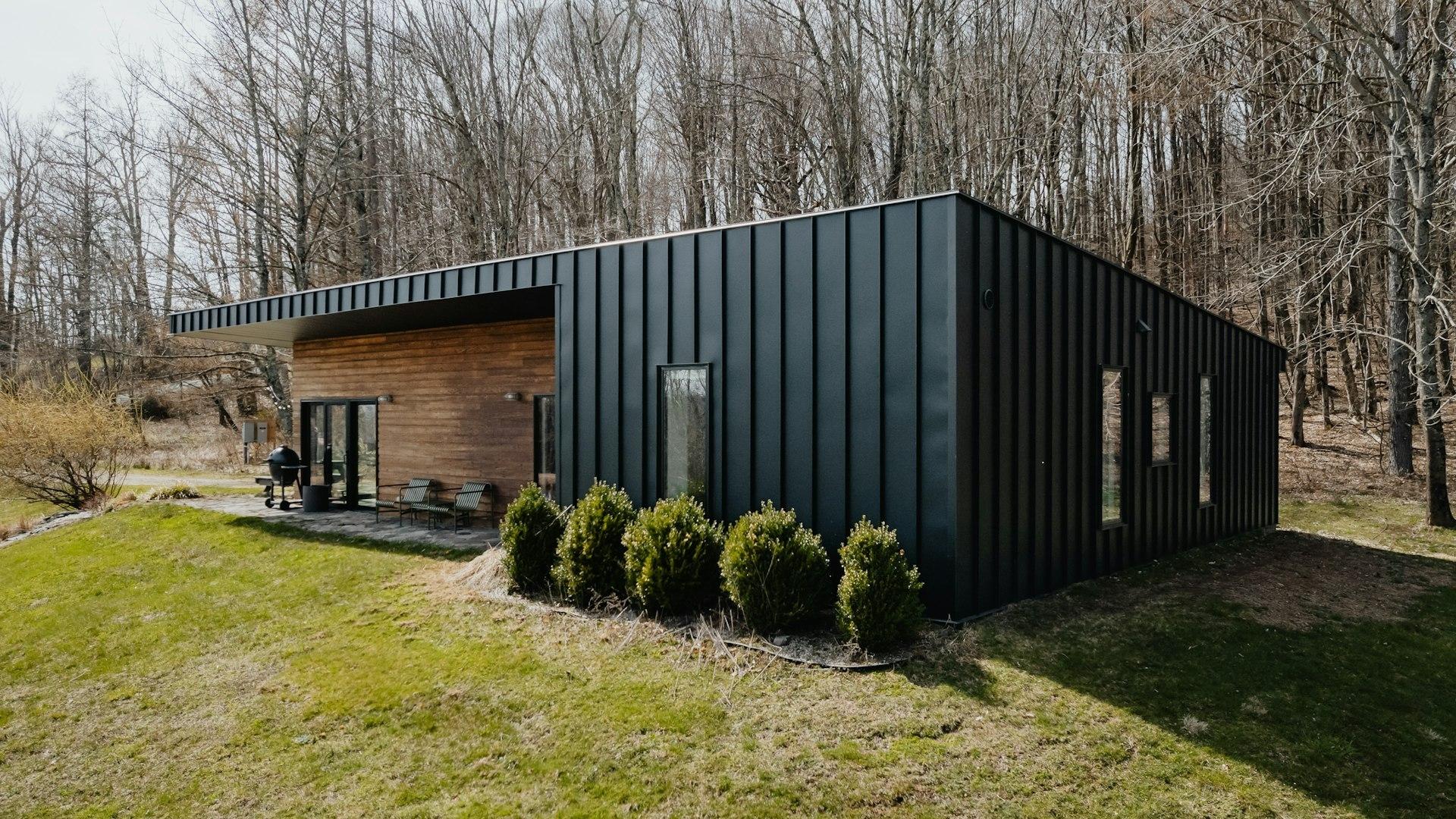
Prefab, modular and container houses are one of the most-asked-about topics among people who own a plot or a weekend property and want to build quickly and predictably. Advertising often promises "no building permit" and "can be placed anywhere". In most cases that is not true — and the mistake gets expensive when an inspection, a sale or a mortgage application comes along.
Under Bulgaria's Spatial Development Act (ЗУТ) what matters is what the building is for and how it is connected to the land, not whether the walls were poured on site or delivered on a lorry. A house intended for permanent living and having the characteristics of a building is, as a rule, a construction. Low-rise residential and holiday houses (up to 10 m) are usually category 5 (Art. 137).
That means the same route as any other house: planning approval, an investment design, a building permit, documented construction and a certificate of entry into use from the municipal chief architect. A prefab house on a foundation goes through the full procedure. We walk through it step by step in our guide to building your own house.
The advantage of a prefab house lies in build time and predictability, not in the paperwork.
Advertisements often point to movable structures under Art. 56 of the Act. These are indeed placed with a municipal placement permit rather than a building permit, and the law expressly treats them as not constructions and not entered in the cadastre.
But Art. 56 lists what they are for: retail and service outlets, amusement structures and temporary housing after disasters. Permanent residence is not on the list. An ordinary house does not become a movable structure just because it was assembled from modules.
Courts look at the real connection to the ground. In one case the Pleven Administrative Court upheld a demolition order under Art. 225a for a structure built without a permit, rejecting the argument that it was movable because it was fixed to a concrete base. The case concerned a shed rather than a modular house, but the reasoning is the same.
Under Art. 110 of the Property Act, immovable property is land, buildings and anything permanently attached to them. Everything else is movable.
A module sitting on a plot without being legalised adds no value in the eyes of a bank valuer or a buyer — if anything, it raises questions.
On agricultural land whose designation has not been changed, only greenhouses and farm-related buildings may be built (Art. 2(4) of the Agricultural Land Protection Act). Ordinance No. 19 of 2012 allows only single-storey buildings for storing produce and equipment on plots up to 10 decares, and on larger plots farm buildings in which the living space is limited and tied to the farm itself.
In other words, a prefab house to live in on a field first requires a change of designation. The procedure, fees and deadlines are in our guide to changing the designation of agricultural land.
Some small garden structures really do need no building permit or go through a simplified procedure — canopies, barbecues, greenhouses, light outbuildings. The limits are in Arts. 147 and 151 and are covered in our guide to garden structures. A dwelling house is not among them.
Since 1 January 2024 new buildings must be designed as nearly zero-energy buildings (Ordinance No. РД-02-20-3 of 2022, Art. 21(1)(1)). That applies to permitted modular houses as well. Ask the manufacturer for the energy section of the design, not just the catalogue value of the panels. What the standard requires is explained in our nZEB house guide.
Yes — but as a house, not as a catalogue product. One market example (checked November 2026, indicative): UniCredit Bulbank offers a dedicated mortgage for a prefab house — up to €260,000 and up to 70% of value, over up to 20 years for a purchase and 25 years for construction. Its conditions include:
Collateral is normally the plot and the building on it, and the loan is drawn in tranches. Loan-comparison sites note that light timber-frame houses are accepted less often and with a bigger valuation discount. How staged construction finance works is in our guide to construction loans.
A prefab house saves construction time, not paperwork. If you will live in it, it is a construction requiring a permit and entry into use. A movable structure is no shortcut, farmland needs a change of designation, and banks finance only a legalised house on a plot you own.
If you have a plot and are considering a prefab house — or want to buy a property that already has one — give us a call or drop by our office. We will review the plot's documents and tell you what can realistically be built and how to make it legal.
Verified as of November 2026. Bank terms are indicative and change — confirm them with the bank before deciding.
