
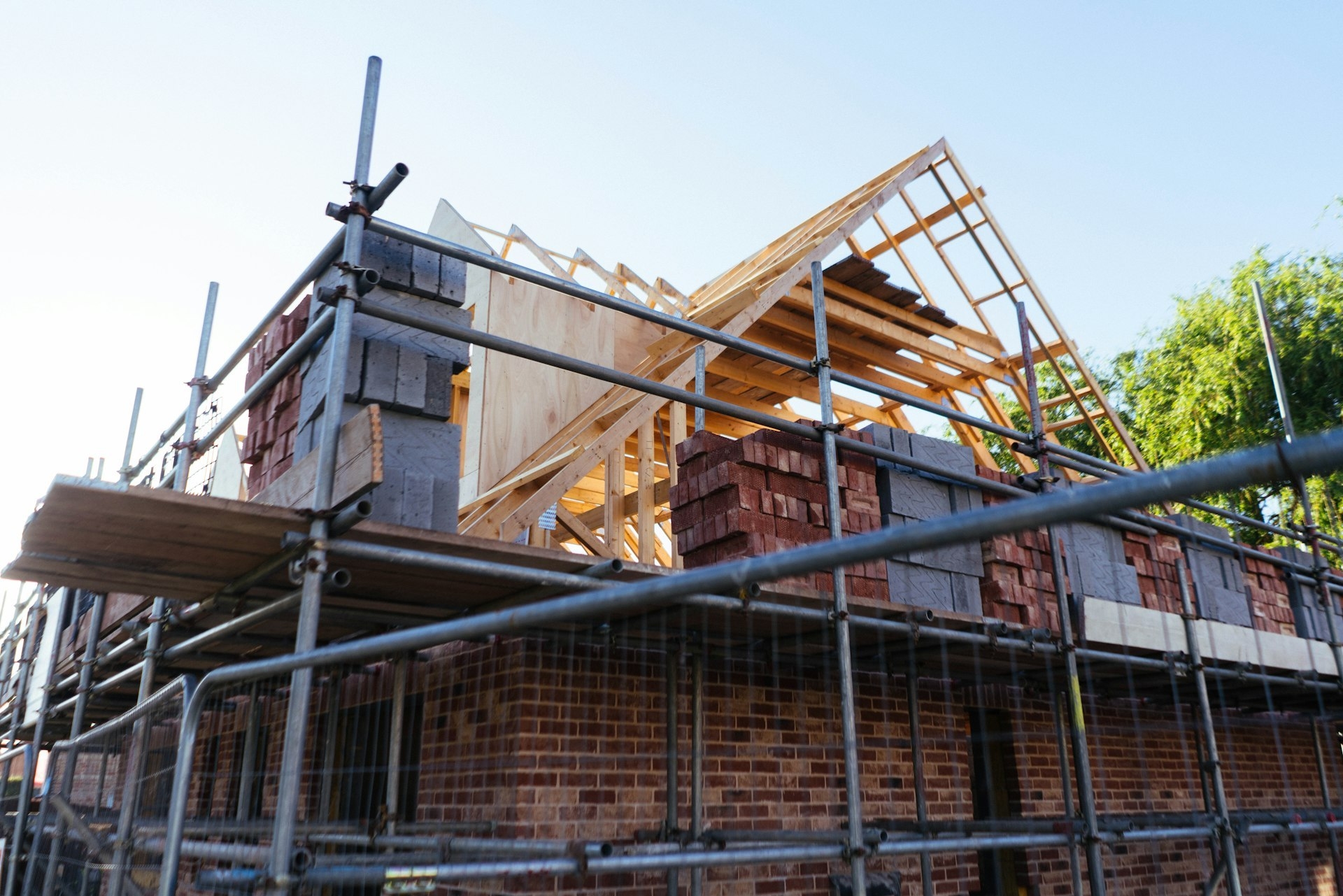
You have bought a plot, you have an approved design and a building permit. This is where most future house owners in Bulgaria hand everything over to the builder — and where the problems start that only surface years later, when the house is sold or a bank is asked for a mortgage.
Our guide on what to check before buying a plot took you as far as the building permit. This one continues: what has to happen between breaking ground and the day the house can lawfully be lived in.
Deadlines and obligations were checked against the consolidated text of the Spatial Planning Act (ЗУТ) as of October 2026. The Act changes often — before a specific project, check the current wording and your municipality's requirements.
The Spatial Planning Act sorts construction works into categories. Low-rise residential buildings fall into the fifth category (Art. 137(1)(5)(a) ЗУТ). That determines who is involved in the build and who signs it off:
No mandatory supervisor does not mean nobody needs to check the work. It means responsibility is split between you, the designer and the site manager — and choosing those people is your decision.
This is the rule people overlook most often. A building permit lapses if (Art. 153(2) ЗУТ):
A lapsed permit can be renewed only once, on a request made within three months of the relevant deadline, for 50% of the original permit fee (Art. 153(4), (5) and (8) ЗУТ). If it is not renewed, the approved design lapses as well (Art. 153(10) ЗУТ) — and the process starts again under whatever rules apply at that point.
In practice: if you plan to build in stages, keep a calendar. And if you are buying a plot "with a permit" or an unfinished house, check the dates — a permit issued years ago may no longer be valid.
Legally, construction starts on the day the protocol opening the site and setting the building line and level is drawn up (Art. 157(1) ЗУТ). That is also when the five-year clock for the shell starts running.
For a house, the site manager files the request for the protocol with the municipality at least 7 days before the date (Art. 157(5) ЗУТ). A municipal official attends, but if they fail to appear the protocol can still be drawn up (Art. 157(6) ЗУТ).
From then on, the site must keep an order book in which every instruction relating to the works is recorded (Art. 170(3) ЗУТ).
Every significant step — handing over the site, work that is later covered up (reinforcement, waterproofing, services inside walls), interim acceptances — is recorded in acts signed by the parties to the contracts (Art. 170(1) ЗУТ). If someone refuses to sign, the other party sends a written invitation; if the invited party does not appear within 24 hours of the deadline, the act is drawn up with the municipality standing in for them (Art. 170(2) ЗУТ).
For the owner, these acts are not paperwork. They are the only proof of what went into the walls and foundations if a crack, a leak or a dispute with the builder appears later. Keep a copy of everything.
If changes become necessary during the build:
Do not start "one more room" or "a higher roof" on a handshake with the builder.
"Act 16" is the shorthand the apartment market uses for putting a building into use. For first- to third-category construction, that happens with a use permit issued by the National Construction Control Directorate (Art. 177(2) ЗУТ). How to read those documents when buying a flat is covered in our guide to Act 14, Act 15 and Act 16.
A fifth-category house is put into use with a certificate of entry into use issued by the authority that issued the building permit — usually the chief architect of the municipality or district (Art. 177(3) ЗУТ). The certificate is issued within 7 days of the application, after the documents are checked and, at the municipality's discretion, an on-site inspection.
The application must include (Art. 177(1) ЗУТ):
A building is not put into use if it was not built according to the approved design, or if the technical passport and energy performance certificate are missing (Art. 178(3)(1) ЗУТ). Until it is put into use, it may not be occupied (Art. 178(1) ЗУТ).
When we sell a house, the first question from a serious buyer — and from their bank — is whether it has a certificate of entry into use. A house that has been lived in for years but stalled at "shell" or "nearly finished" sells with more difficulty, for less, and usually without a mortgage.
Completing the paperwork years later is possible, but often more expensive: the designer or site manager is no longer around, the acts are incomplete and the cadastre does not show the building. For the checks we run on older houses and cottages, see our guide to buying a village house near Sofia.
An unfinished house can be a good buy — if the paperwork is in order. Before you pay, ask for:
A single-family house is a fifth-category construction: no mandatory construction supervisor, but a mandatory site manager and designer's supervision. The building permit lapses if works do not start within three years or the shell is not finished within five. Everything during the build is documented, and the finish line is a certificate of entry into use from the municipality — without it the house cannot lawfully be occupied and is hard to sell.
If you are building, finishing, or thinking of buying a house that is still under construction — call us or come into the office. We will go through the documents with you and tell you what is missing while it is still easy to obtain.
