Insulating the external walls of your own flat in Bulgaria: is a permit needed, do the neighbours have to agree, and what are the risks?
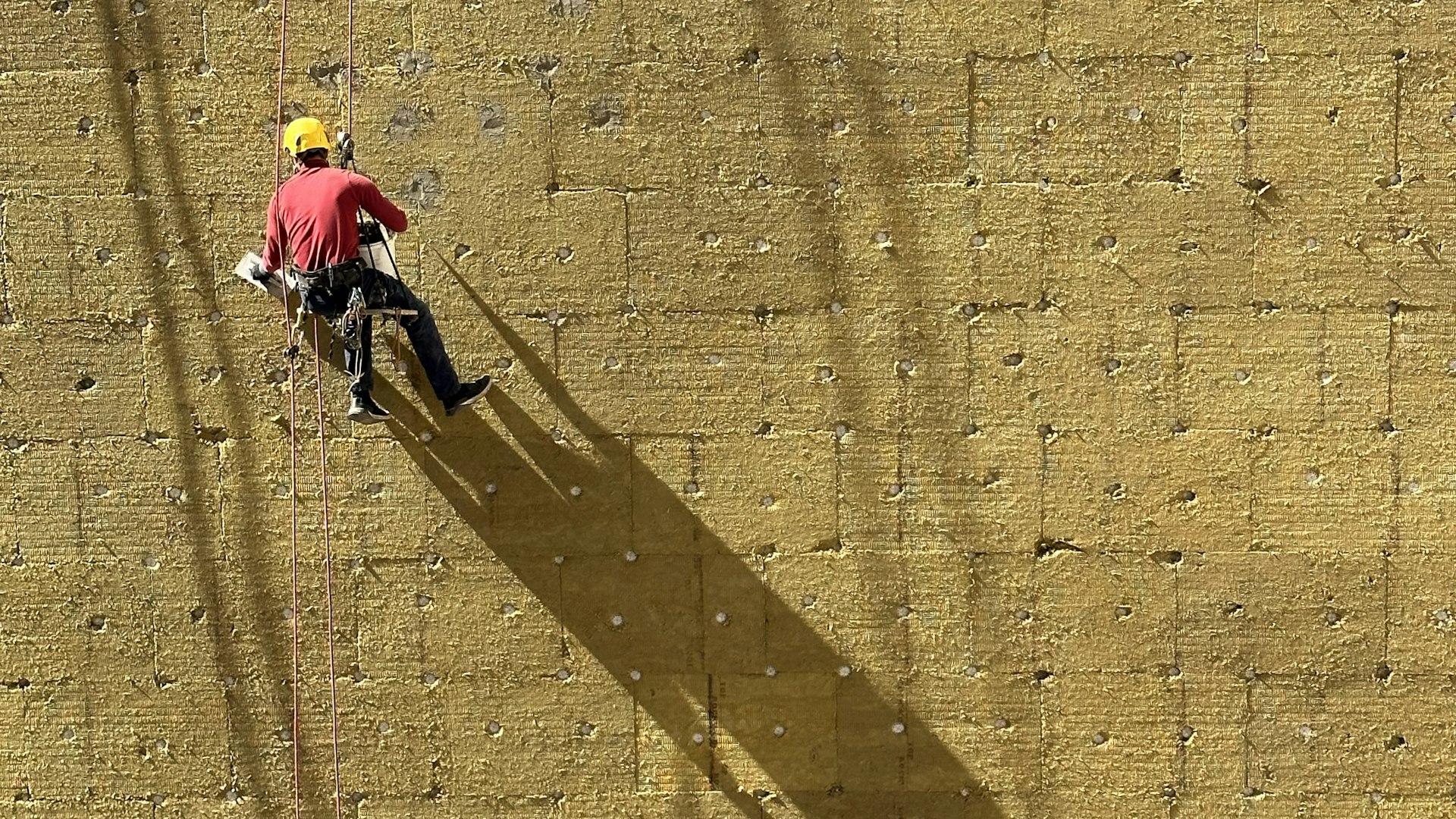
When the whole block cannot agree on a thermal renovation, many owners solve the problem themselves: they hire rope-access workers and insulate only the external walls of their own flat. The result is visible from a distance — patches of different colours across the façade. Is it lawful, do you need the neighbours' consent, and what are you risking?
The answer lies in three laws: the Property Act (ЗС), the Spatial Development Act (ЗУТ) and the Condominium Management Act (ЗУЕС). This guide deals only with insulating a single flat. For whole-building renovation, see our guide to apartment-block renovation in 2026.
The external wall is not yours alone
Under Art. 38(1) of the Property Act, external and load-bearing walls are a common part of the building — they belong to all owners according to their ideal shares. That includes the stretch of façade outside your living room: by its nature it serves the whole building and cannot be your individual property.
So insulating "my wall" is really work on a common part. The Condominium Management Act requires every owner not to carry out works in the common parts, including on the façade, that breach their integrity (Art. 6(1)(19)). We came across the same duties with air-conditioners on the façade.
Do you need a building permit?
The prevailing view in legal commentary is that external insulation, or replacing the external render, of a single unit is routine repair — improvement and maintenance that does not affect the structure (§ 5, item 43 of the Additional Provisions of the Spatial Development Act). Routine repair needs no building permit (Art. 151(1)(1)).
Two important caveats:
- if the building is a listed cultural monument or lies in its protection zone, even routine repair may only be carried out after clearance under the Cultural Heritage Act (Art. 151(2)). Work done without clearance is unlawful and its removal can be ordered;
- if the insulation is part of larger works that affect the structure or count as major repair, it is no longer routine repair and needs a design and a permit. The general rules on works in a block are in our guide to renovating a flat in an apartment block.
"No permit" does not mean "no consent". Because the wall is common, the decision still belongs to the condominium.
The neighbours' consent: which majority?
The Act does not expressly regulate routine repair of part of the façade requested by one owner. In practice:
- a general-assembly decision — according to the commentary, by analogy a majority of more than 50% of the ideal shares represented is enough (Art. 17(3) ЗУЕС). This is the safest route;
- if the condominium itself bears the cost as a useful expense (a non-essential improvement), the majority is 75% of the ideal shares (Art. 17(2)(3));
- major renovation of the whole building — including with public funding — needs 51% (Art. 17(2)(5)).
How the assembly is convened, the quorum and the minutes are covered in our guide to the general assembly of a Bulgarian apartment block. The decision should record the material, thickness, colour and render, who pays and who is liable for damage.
When there is mould: necessary repair
If insulation is needed to remove mould and damp in the flat, it may qualify as necessary repair — work without which the common part does not meet technical requirements. The Sofia City Court held exactly that in Decision No. 263004 of 20 September 2022, cited in legal commentary.
The difference matters:
- for necessary repair the law lets an owner act alone: if they have notified the building manager and no general assembly has been convened within one month, they may carry out the repair with their own funds and recover the costs from the condominium or its repair and renovation fund (Art. 48(6) ЗУЕС);
- for necessary repair, the other owners owe their share according to their ideal shares.
Keep evidence: photos of the mould, a specialist's assessment, the written notice to the manager.
Who pays if you insulated without a decision
If you insulated without a decision and it was not necessary repair, you usually pay yourself. The neighbours owe compensation at most up to the amount by which they were enriched — that is, by which the value of the common parts increased (Arts. 61(2) and 59 of the Obligations and Contracts Act). In practice that rarely covers the cost.
The technical risks of a patch
The legal side is only half the story. Partial insulation has physical limits too:
- thermal bridges along the boundary with uninsulated neighbouring sections and around slabs and balconies — the wall stays cold there and condensation can form;
- condensation and mould move — sometimes to the neighbour, sometimes into the corners of your own room. Calculating the dew point is a job for a designer, not the installer;
- fixing anchors into an old wall and the fire-safety requirements for the system must be respected — ask for materials with declarations of conformity and a written warranty;
- future renovation — if the block later joins a programme, ask the manager and the designer how your insulation will be treated.
Work at height should go to a firm with safe access — rope access or scaffolding, with the area below cordoned off.
If you are buying a flat with external insulation
- Ask for the general-assembly decision, if there is one, and whether the work has been paid for.
- Check whether the building is a cultural monument or in a protection zone — if so, the insulation needed clearance.
- Look at corners, around windows and under balconies for stains and mould — a sign of poor workmanship.
- Ask whether there is a dispute with neighbours or the condominium about the façade.
- Ask about any upcoming renovation of the block and how it would affect the already insulated flat.
Insulation is a real plus for bills and comfort, but only when it is lawful and properly done.
In short
- The external wall is a common part (Property Act Art. 38) — insulating it affects every owner.
- It is usually routine repair needing no building permit (Spatial Development Act Art. 151(1)(1)), except for listed buildings and their protection zones.
- The safest route is a general-assembly decision recording material, colour and liability.
- Where there is mould, insulation may be necessary repair — with the right to act alone after notifying the manager.
- Technically, partial insulation needs care with thermal bridges and condensation.
If you are buying a flat in a block with a partly insulated façade, or want to know how insulation affects the sale price of your home — call us or visit our office. We will go through the documents and the condition of the building together.
The information is general and indicative and does not replace professional advice.

