The children's room is the only room in a home that changes its purpose every few years: a nursery, then a playroom, then a study, and finally a teenager's room with the door firmly shut. The best decisions here are therefore flexible and safe rather than decorative. And because many families sell or move precisely when the children grow up, it is worth thinking about how this room will look to a buyer.
Safety before furniture
Most accidents at home involve ordinary objects. A few rules that cost almost nothing:
- Anchor tall furniture to the wall – wardrobes, shelving units, chests of drawers. Children climb drawers like a ladder. Most manufacturers include fixings; in a concrete panel block use proper concrete plugs, and in plasterboard use cavity-wall anchors.
- Windows – do not put a bed, desk or toy box under a window, because it becomes a step. Lockable handles or opening restrictors are a cheap and very effective measure, especially on higher floors.
- Blind and curtain cords are a genuine strangulation risk. Since 2011 the EU (Decision 2011/477/EU) has required safety requirements for internal blinds to prevent hazardous loops for children up to 42 months. On older blinds, remove loops, shorten the cord or wind it high on a cleat – and never place the cot next to the window.
- Sockets and cables – socket covers, cables tucked behind furniture, no extension leads on the floor.
- Bunk or high beds – manufacturers, referring to the EN 747 standard, state clearly that the upper bed is not suitable for children under 6. Check the guard rail and ladder, and hang nothing on the bed that a child could get tangled in.
Furniture that grows with the child
The most expensive mistake is a "themed" room that has to be replaced entirely three years later. A better approach:
- Bed – a cot with an adjustable base that later becomes a small bed, or simply a standard single bed with a temporary side rail. A good mattress matters more than the frame.
- Height-adjustable desk and chair – they will serve from the first year of school to the last. A chair that lets the feet rest flat on the floor matters more than the brand.
- Neutral carcasses, changeable accents – white, light grey or natural wood for the wardrobe and cabinets; colour comes from textiles, cushions and artwork, which can be changed quickly and cheaply.
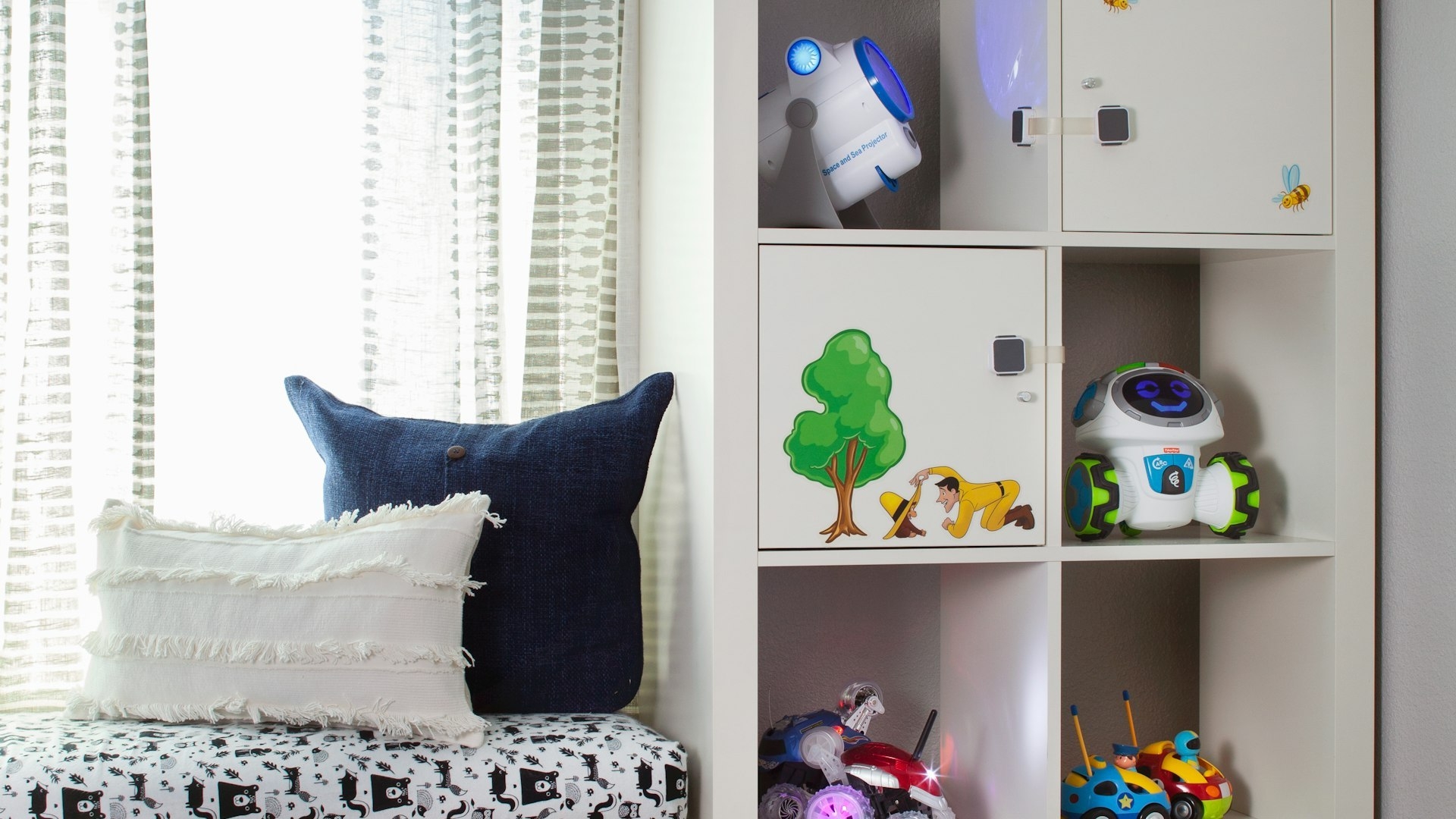
- Modular shelving – cube shelving like the one in this article's photo holds toy boxes today and books tomorrow.
If you choose chipboard or MDF furniture, pay attention to emissions – doubly so in a child's room. Air the room regularly; for damp and mould around the bed and external walls, see our guide to healthy indoor air.
Storage the child can use alone
Children tidy up only if they can reach. Low open shelves, lidless boxes and hooks at their height do more than a large wardrobe with tall doors. The rule "everything has a place" works for adults and children alike.
- The lower zone (up to roughly the child's height) – toys and everyday things.
- The upper zone – seasonal clothes, papers and things the parents take down.
- Under-bed drawers – bedding and bulky toys.
- Fewer toys on display. Keep some in a box in the storage room or a top cupboard and rotate them every few weeks – the room looks larger and the child plays more.
In a small room in a panel block, built-in solutions often gain space but make the room harder to change later. When they are worth it and when they are not, we cover in our guide to small spaces.
Light for sleep, play and study
- By day – the desk beside the window, so light comes from the side rather than from behind (otherwise the child writes in their own shadow).
- In the evening – warmer, softer light and a night light; darkness for sleep (blackout curtains or blinds without hazardous cords).
- The study area – a separate desk lamp in addition to the ceiling light.
For layers of light and colour temperature, see our guide to lighting your home.
Walls and floor
Washable paint is a better choice than wallpaper. A magnetic or blackboard wall is fun, but limit it to part of one wall – it is easy to repaint before a sale. Underfoot, choose a warm, easy-to-clean floor and a washable rug.
If you sell: the room as an "extra bedroom"
Buyers are not buying the cartoon characters on the wall. From our experience at viewings:
- Neutralise – repaint strong colours, remove stickers and name lettering from the walls (also for privacy in the listing photos).
- Show flexibility – a room that photographs as a bedroom or a study reads as an additional room. That matters a great deal in two- and three-room flats.
- Fewer toys, more floor. Packed-away toys make the room look several square metres larger.
- Repair the marks – holes from frames, scuffs on the door, broken handles.
- Fitted furniture – make clear which built-in pieces stay and write it into the contract.
In short
- Safety first: anchored furniture, nothing under the window, blinds without loops, upper bunk only from age 6.
- Neutral, adjustable furniture; colour through changeable accessories.
- Low, reachable storage and rotating toys.
- Desk by the window, warm evening light, darkness for sleep.
- When selling – neutral walls and a room that can be a bedroom or a study.
Talk to us
If you are thinking of moving to a larger home because the children are growing, or want to sell your current one, call us or come into the office. We will look at the home together and tell you what is worth changing before the photographs.
This is general information and does not replace specialist advice for your specific case. Verified as of October 2026.