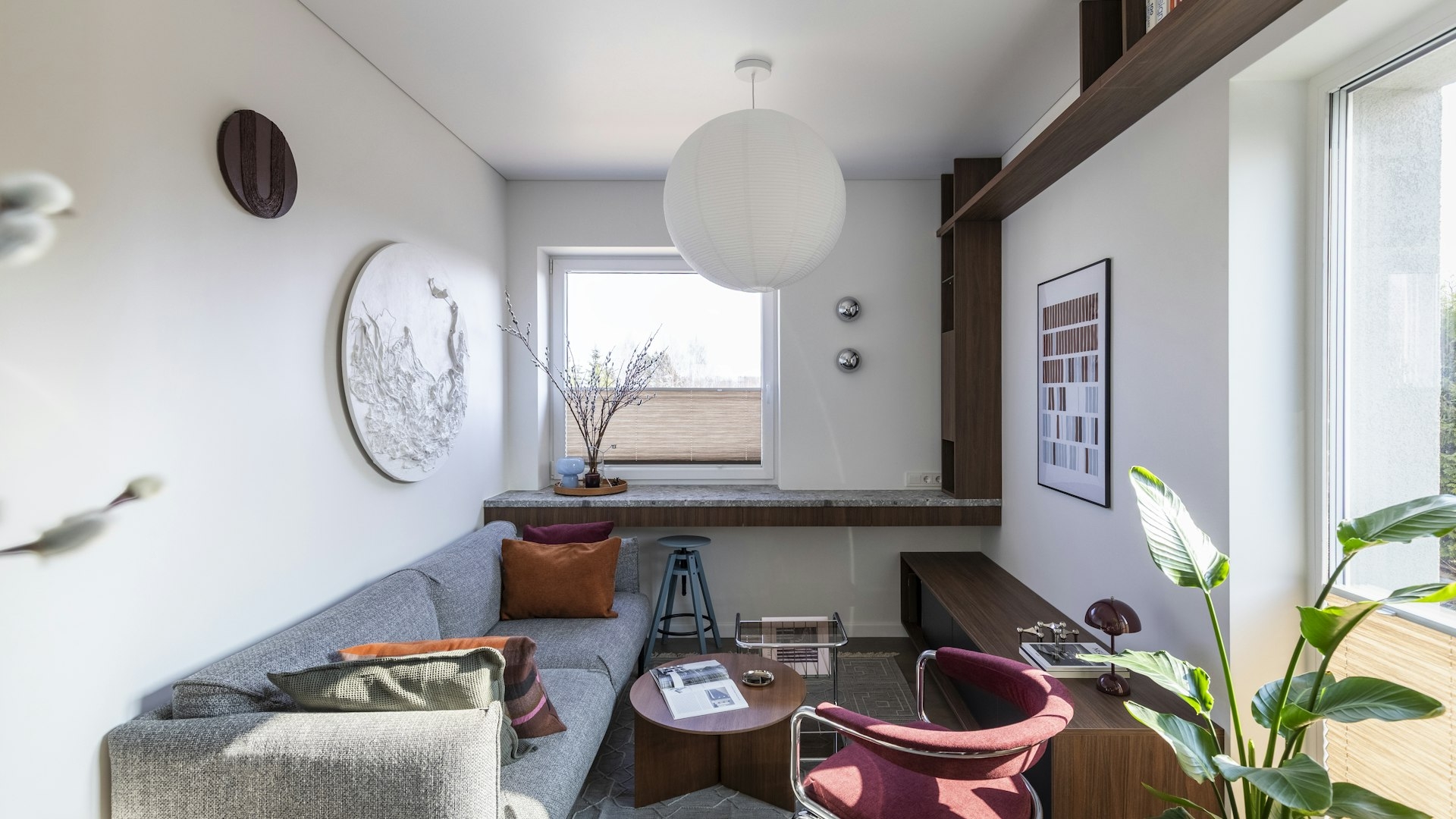
Many of the homes we see each week are small: a two-room flat in a prefabricated panel block, a 1970s brick flat with a narrow hallway and a kitchen alcove, a village house with thick walls and windows barely wider than an arrow slit. In spaces like these every decision shows, whether you live there, let the property or sell it. Here is our practical approach: light and order first, then furniture, and walls last, if at all.
1. Light before colour
In a small space, light does more than any paint.
- Clear the windows. Heavy curtains, a wardrobe across half a window and tall pots on the sill take up more space than you think. A light curtain or a blind fixed above the frame makes the window look taller.
- Several light sources, not one ceiling fitting. A ceiling light plus one or two lamps at eye level (floor, table or wall) make a room feel wider in the evening. In a narrow hallway, light the whole length, not just the door.
- A mirror opposite or beside the window bounces daylight further in. Opposite the front door it mostly shows the clutter first.
- Light, matt walls and ceilings; the floor can be darker so the room feels grounded.
Colour, textiles and style are a separate subject, covered in our guide to decorating your own home. One rule matters here: in a small room, one calm base tone and a few accents work better than many colours.
2. Built-in or free-standing furniture
| Built-in (made to measure) | Free-standing |
|---|
| Use of space | Maximum: up to the ceiling, in alcoves, under stairs, above doors | Less: gaps remain above and at the sides |
| Flexibility | Stays with the property | Moves with you |
| When letting | Convenient if solid and neutral | Easy to replace when worn |
| When selling | A plus if neutral and in good condition; a minus if heavy, dark or very personal | Neutral: buyers picture their own |
In our experience, a built-in hallway wardrobe, a made-to-measure kitchen and a cupboard above the door are almost always seen as a plus. A built-in bed, a bar counter across half the living room or a wall of dark units often has buyers working out what removal will cost. If you build to measure, keep it light, simple and in places where anyone would put a cupboard.
Furniture that helps a small room: a sofa bed with storage, an extending table, a bed with drawers, shelving to the ceiling, wall-mounted units instead of floor cabinets. The more floor you can see, the bigger the room looks.
3. Walls: ask before, not after
The most expensive mistake in a small home is "let's open the kitchen into the living room" without checking first.
- Under Art. 151(1)(1) of the Spatial Development Act (ЗУТ), routine repair needs no building permit. Under § 5, item 43 of its Additional Provisions, routine repair includes internal alterations only if they do not affect the structure or change the loads.
- Once a wall is load-bearing, or the work affects a slab, column or beam, you need a design and a building permit (Art. 148(1) ЗУТ) and, in a block, the consent required by Art. 185 ЗУТ. The Condominium Management Act (ЗУЕС) obliges every owner not to impair the building's load-bearing capacity (Art. 6(1)(5)).
- In panel blocks the interior panels are often load-bearing; in EPK (cast-in-place large-formwork) blocks many interior walls usually are too. In 1970s brick buildings the walls carrying the slab are load-bearing, and you cannot tell by looking.
So before you hire a builder, get a written opinion from a structural engineer. A wall removed illegally does not show on the title deed, but it shows at a viewing, against the approved drawings and in the bank's valuation. The buyer and their lawyer will ask; see also what a buyer checks before purchase.
Light partitions (plasterboard, or thin brick that carries no load) are easier to move, but an engineer's note is still worth having if you will sell later.
4. The old house: thick walls, small windows, high ceilings
An old village or town house plays by different rules.
- Small windows are not a defect to be "fixed" by knocking out masonry. Thick stone or brick walls keep the summer heat out. Gain light with white window reveals, light floors and lamps, not with a wider opening that may affect the structure.
- High ceilings feel airy but are hard to heat, and a ceiling you cannot reach with a ladder is also hard to paint. If you lower it with a suspended ceiling, keep enough height that the room does not feel squashed, and never cover vents.
- Damp is the first thing we look at. Stains at the base of the walls, blistering plaster, a musty basement: the cause is usually outside, such as gutters, drainage around the foundations, or cement render on old masonry that needs to breathe. Fix the cause first, then paint. Paint over a damp wall only postpones the problem, and buyers notice.
- Zoned heating. In a large old house it rarely makes sense to heat every room. The practical answer is one or two well-insulated "winter" rooms on the main heating, doors that close between zones, and cooler bedrooms. Buyers accept this when it is clear how each room is heated and what winter costs.
Energy class is set to appear more often in listings; see what the draft amendments to the Energy Efficiency Act propose. The clearer your heating story, the easier it is to explain to a buyer or tenant.
5. What makes a small home harder to sell later
In our practice, most often:
- walls removed or opened without paperwork: the most serious issue, because it affects both the bank and the notarial deal;
- a bathroom or kitchen moved above a neighbour's bedroom: a source of disputes and of questions at viewings;
- everything built in and very personal: dark units to the ceiling, a built-in bed, odd levels and platforms;
- a balcony "absorbed" into a room without a design;
- damp hidden under fresh paint: found at the first corner a buyer inspects;
- unclear heating: nobody knows what winter costs.
Quick checklist
Next steps
If you are thinking of buying, preparing for letting or selling a small flat or an old house, call us or visit our office. We will look at the property with you and tell you which changes are worth making and which are better left to the next owner.