
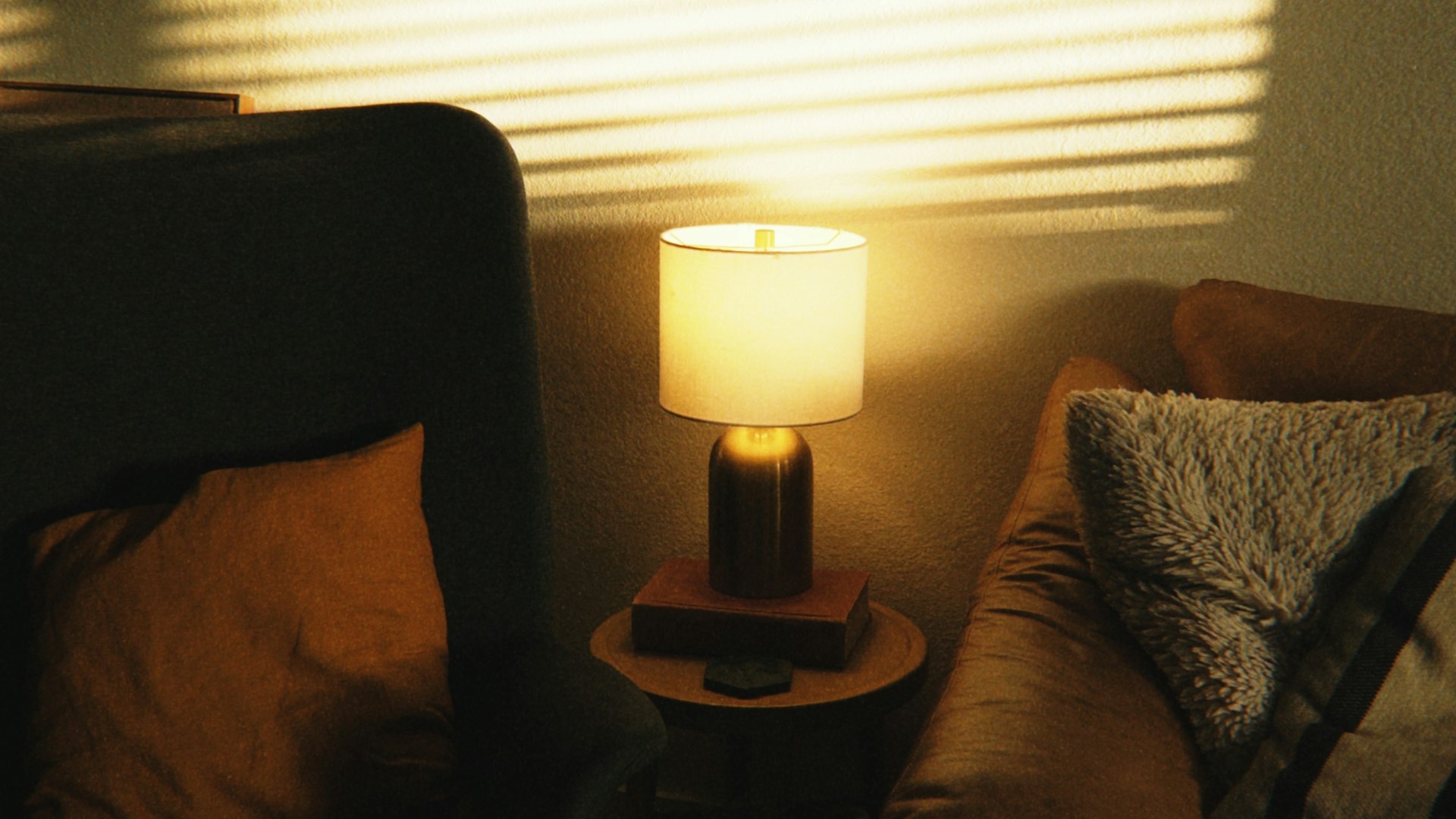
Lighting is one of the few things in a home you can change quickly and cheaply, and the effect is large — for you while you live there, and for the buyer or tenant walking in for the first time. Here is a calm, practical summary: what good lighting is made of, what the box actually tells you, and what matters if you are selling or letting.
The most common mistake we see on viewings is one strong ceiling light in the middle of the room and nothing else. The room ends up either flat and glaring or dark in the corners. The fix is three layers that you switch separately:
| Layer | What it does | Examples |
|---|---|---|
| General | Even light so you can move around | ceiling fitting, pendant, recessed downlights, LED profile |
| Task | Strong, directed light where you read, cook or do make-up | under-cabinet kitchen light, desk lamp, bathroom mirror light |
| Accent | Depth and atmosphere; picks out a wall, picture or niche | floor lamp in a corner, wall light, LED strip in a shelf |
In the evening it is usually enough to dim the general light and switch on the accent lamps. If you are renovating, plan separate switches or circuits for each layer — adding them later costs far more.
Watts tell you how much electricity a lamp uses, not how bright it is. LED brightness is measured in lumens (lm). A commonly used comparison with old incandescent bulbs (per Selectra):
| Old bulb | Approximate light output |
|---|---|
| 40 W | 470 lm |
| 60 W | 806 lm |
| 75 W | 1,055 lm |
| 100 W | 1,521 lm |
For efficiency, compare lumens per watt (lm/W) — the higher, the less electricity for the same light.
The colour of light is given in kelvins (K):
The key rule is consistency: don't mix colour temperatures in one room. A mix of yellow and bluish white makes even a beautiful room look untidy — and it shows strongly in photos.
The colour rendering index (CRI, Ra) shows how natural colours look under a lamp, on a scale up to 100. Under a cheap low-CRI lamp, wood looks grey and skin looks pale. Where colour matters — the kitchen, the bathroom mirror, the wardrobe — look for Ra 90 or higher; it is printed on the box or in the data sheet.
Since 1 September 2021, lamps and LED modules in the EU have carried a new, rescaled energy label under Commission Delegated Regulation (EU) 2019/2015. Classes again run from A to G, with no "A++". The bar for class A is high — 210 lm/W — so don't be surprised to find a good LED lamp in a lower class; it is a stricter yardstick, not a worse product.
The label shows:
Old and new labels could appear side by side in shops until the end of February 2023; only the new one applies since.
If your kitchen or hallway still has long fluorescent tubes, or you use compact "energy-saving" lamps (CFLs), they are on their way out. The reason is mercury: under the EU's RoHS rules, Directives (EU) 2022/276 and 2022/284 ended the exemptions that allowed mercury in them — from 24 February 2023 for most compact fluorescent lamps and from 24 August 2023 for the common T5 and T8 tubes. New lamps of these types can no longer be placed on the market; the ones you have can be used until they fail.
In practice, when a tube dies it usually makes more sense to replace the fitting with LED than to hunt for a spare. A broken or spent fluorescent lamp does not go in the household bin — take it to a collection point for waste electrical equipment (large lighting and electronics shops usually have boxes).
| Room | What works well |
|---|---|
| Living room | dimmable general light + 2–3 accent lamps at different heights; warm 2,700–3,000 K |
| Kitchen | lighting under the wall cabinets onto the worktop, neutral 3,000–4,000 K, high CRI; a ceiling light alone casts your shadow on the counter |
| Bedroom | soft bedside lamps, no harsh cool light; a switch by the bed |
| Bathroom | even light around the mirror, not only from above; fittings designed for damp rooms |
| Hallway | enough general light, a sensor or switches at both ends |
| Desk / children's room | a desk lamp with good CRI and no glare on the screen |
In a rental flat, stick to standard bases (E27, E14, GU10) — tenants can replace a bulb themselves, and you don't get calls about the "special lamp". For broader furnishing decisions, see our guide to decorating your own home.
No lamp replaces a window. Orientation decides how much light comes in, and what kind:
In our practice, buyers almost always ask which way a flat faces, and they feel it the moment they walk in. When you are the buyer, see the home at different times of day — in the morning and after dark.
If you are selling, we cover pricing and viewing preparation in our guide to selling in autumn. Here is only the part that depends on light:
If you are getting a home ready to sell or let and would like a second pair of eyes — including on how it looks in photos and in the evening — give us a call or drop by our office. We'll look at it together before buyers do.
Information verified October 2026.
