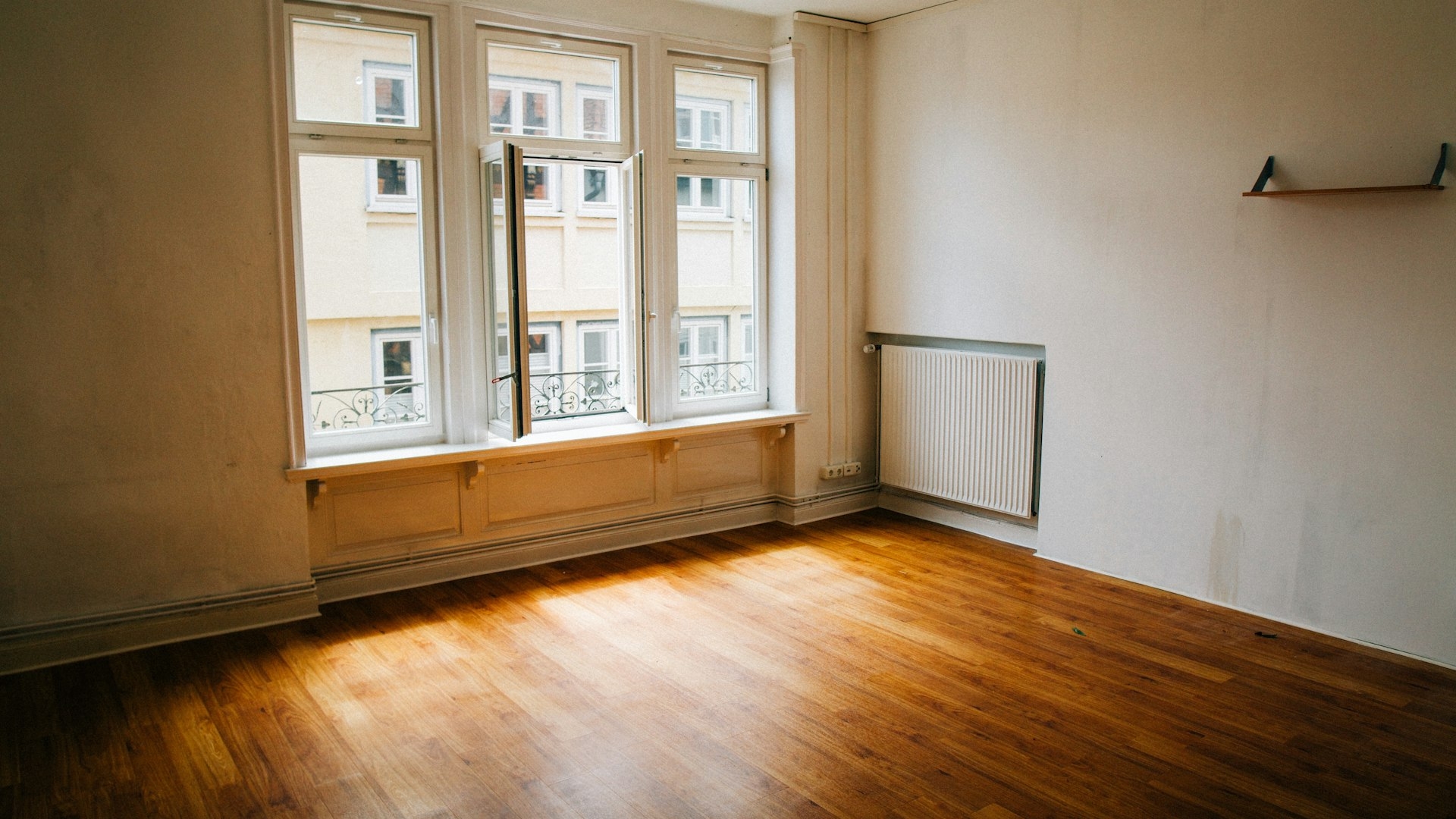
A listing is designed to get you to the front door. The viewing is your only chance to check for yourself what the photos leave out: the smell of damp, the noise from the boulevard, the water pressure and the state of the stairwell. This is the checklist we use with our buyers — print it or keep it open on your phone.
Before you go
- Ask for the exact address, floor and floor area and look at the building from the outside (street view on a map works).
- Book the viewing in daylight. Artificial light hides stains, cracks and signs of leaks.
- Bring: a torch (or your phone), a tape measure, a phone charger (to test the sockets) and a notebook. Take photos of everything — after the third viewing, flats start to blur together.
Damp and mould
This is the problem most often "refreshed" with a coat of paint just before a sale.
- Corners — especially the upper corners of external walls and the corners behind wardrobes. Dark spots or stains mean condensation or a leak.
- Under and around the windows — the sills, the corners of the frames, the wall under the radiator.
- Bathroom and kitchen — the grout around the bath and shower, the ceiling above the shower, the wall behind the toilet. Is there a working extractor fan or a window?
- The ceiling — especially on the top floor (roof) and below the upstairs neighbour's bathroom.
- The smell — if you walk into a flat with every window open on a cold day, ask why. A musty smell is a signal that paint cannot hide.
- The basement — if the flat comes with a storage cellar, go down. Damp there tells you about the foundations and waterproofing.
If you see one freshly painted patch on the ceiling, ask what was there.
Water and drainage
- Run the taps in the kitchen and bathroom at the same time and see how much the pressure drops. Run the hot water too — how long does it take to arrive?
- Flush the toilet and wait to see whether the cistern keeps running.
- Look under the sinks — water marks, rust, towels or containers placed there.
- The pipes — where visible, are they old galvanised steel or newer plastic? Were they replaced up to the vertical riser or only the visible part?
- The riser — in Bulgarian law the main lines of a building's installations are common parts owned by all owners (Art. 38 of the Property Act, ЗС). Repairs affect every neighbour and are usually decided by the owners' association, so ask when the riser was last replaced.
Electrics
- The fuse board — look at it. Circuit breakers and a residual-current device, or old screw-in fuses? Are the circuits labelled?
- The sockets — plug your charger into several of them. Loose, scorched or warm sockets are a serious warning sign.
- The cables — if the seller says the wiring was "partly replaced", ask which part. Older buildings can still have aluminium conductors. Wherever aluminium is joined to copper, the connection is vulnerable: with moisture it oxidises, resistance and temperature rise, and there is a fire risk. Only an electrician can judge the condition — if in doubt, bring one to the second viewing.
- Capacity — if you plan an induction hob and air conditioners, ask whether the flat's supply is sufficient.
Windows and heating
- Open and close every window. Does it shut tightly? Is there condensation between the panes, or a draught around the frame?
- The balcony door and any glazed-in terrace — seals, rust on metal parts.
- Heating — district heating, air conditioning, gas or electric? Ask for last winter's bills — they say more than any explanation.
- Radiators — are they warm if the heating season has started? Are there individual heat-cost allocators and valves?
- Insulation — has the building been insulated? If not, ask whether the owners plan it. (Where the renovation programmes stand: Apartment-block renovation in Bulgaria in 2026)
Noise, light and orientation
None of these can be fixed with a renovation, so give them more attention than the kitchen.
- Visit at different times. A quiet Sunday afternoon tells you nothing about the 8 a.m. traffic, the bar downstairs on a Friday night or the school playground at break time.
- Close the windows and listen. Can you hear the neighbours, the lift, the stairwell?
- Orientation — which way do the bedrooms and living room face? Use the compass on your phone. South-facing rooms are brighter and warmer, north-facing ones cooler, and west-facing rooms overheat on summer afternoons.
- The view — is there an empty plot opposite? Ask what the development plan allows there.
The entrance, common areas and lift
You are buying not just a flat but a share of a building.
- Entrance and stairwell — cleanliness, lighting, leak marks on the walls, the state of the post boxes.
- The lift — does it work, is there a sign showing the last technical inspection, is it noisy?
- The roof and top floor — if you can, go up to the top landing. Leaks there affect everyone.
- The façade — cracks, falling render, a patchwork of individually insulated flats.
- The building manager — ask who it is, how contributions are collected, whether there is a repair and renovation fund and when the owners last met. How to look the building up in the public register: Your building manager is now in a public register.
Parking and the neighbourhood
- Where do residents park? Walk around at 8–9 p.m. — that is when you see the real picture.
- Paid parking zones (blue or green zone in Sofia), a space in the yard — who uses it and on what basis?
- Walking distance to transport, shops, schools and kindergartens. Walk it rather than measuring it on a map.
The questions to ask the seller
Ask calmly and write the answers down. You will need them in negotiations and when comparing the documents.
| Question | Why it matters |
|---|
| Why are you selling? | It shows how quickly the seller needs to sell and whether there is a hidden problem (a neighbour, noise, a leak). |
| What are the monthly bills — electricity, water, heating, building fee? | Ask for actual invoices, not estimates. |
| What work has been done, and when? | Wiring, plumbing, windows, bathroom, the building's roof. Are there invoices or warranties? |
| Have there been leaks — from you to the flat below or from above to you? | A recurring leak points to a problem in the shared installations. |
| Are there disputes in the owners' association or with neighbours? | Unpaid contributions, lawsuits, disputes over attics, cellars or parking. |
| Is anything owed to the owners' association or to utility providers? | Ask for the latest paid bills and confirmation from the building manager. |
| What stays in the flat? | Kitchen, appliances, air conditioners, light fittings — write it down now. |
| When can you move out? | Important if you are synchronising with a sale or a lease. |
The legal due diligence — title, encumbrances, mortgages, tax debts — is a separate step. We cover it in detail in Legal checks before buying a property in Bulgaria.
The second viewing
If you like the flat, do not pay a deposit after the first viewing.
- Come back on a different day and at a different time — a weekday morning or an evening.
- If possible, come after rain — leaks and damp show best then.
- Bring someone who is not in love with the flat — they will notice what you overlook.
- Measure — rooms, alcoves, the space for the fridge and washing machine. The area in the documents and the usable floor area are not the same thing.
- Check the answers — compare what the seller told you with the bills and documents.
When to bring a specialist
Not every viewing needs one, but in these cases it is worth it:
- Electrician — old or "partly replaced" wiring, screw-in fuses, warm sockets, a planned increase in load.
- Plumber — signs of leaks, low pressure, old pipes inside the walls.
- Structural engineer — cracks in walls, especially diagonal ones or around openings; a planned layout change or wall removal; doubts about the roof or foundations.
- Damp and insulation specialist — mould that keeps coming back, or damp walls in the basement and on the ground floor.
An hour of consultation costs little compared with the repair you would otherwise discover after moving in.
This is general information about viewing a home. It does not replace a professional assessment of the property's technical condition or legal advice on a specific case.
Viewings are our everyday work
If you would like to view a property with a broker who knows what to ask, call us or visit our office. We will help you see what is not in the listing.