
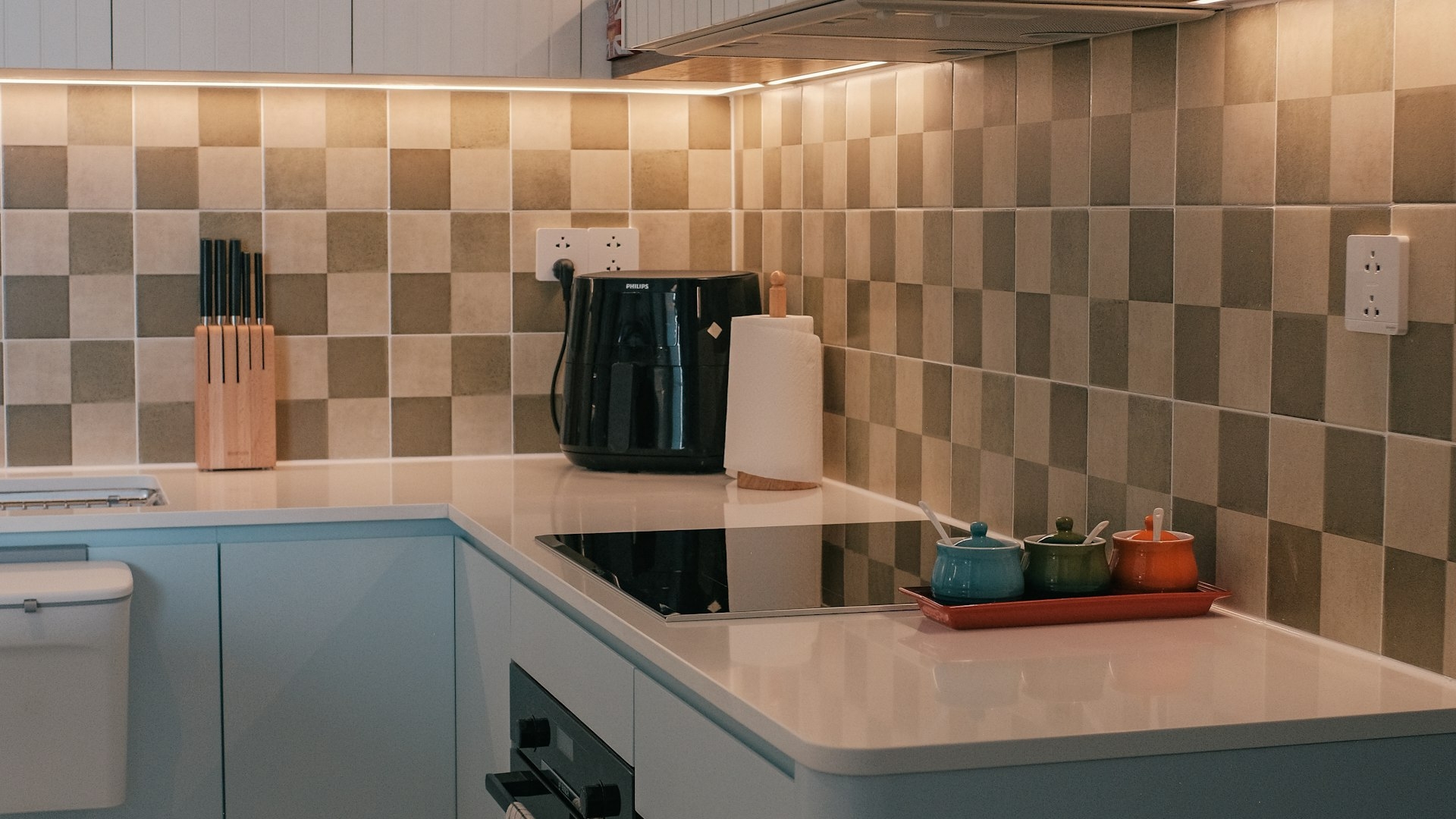
The kitchen is the room buyers inspect most closely, and the room where money is most easily spent without much to show for it. A good kitchen is not the most expensive one; it is the one that is comfortable to cook in, easy to clean and still looks decent ten years on. Here is how to approach it, with an eye on the day you might sell.
The classic rule links the three key points – fridge, sink and hob – in a triangle. The idea is simple: short distances between them, and no door, corridor or island that everyone walks across cutting through it.
It is more useful to think in zones, arranged in the order you cook:
The most common mistake we see at viewings: a hob pushed into a corner or against a wall with nowhere to put a pan down, and a fridge whose door opens against the worktop.
| Layout | Suits | Watch out for |
|---|---|---|
| Linear (one wall) | narrow kitchens, studio kitchenettes | little worktop; keep sink and hob apart |
| L-shaped | the typical small panel-block kitchen, kitchen-diners | the corner unit – fit a pull-out mechanism or it becomes dead space |
| U-shaped | wider enclosed kitchens | below roughly 2.4 m width the aisle is tight for two people |
| Island or peninsula | kitchen-diners in new builds | islands need clearance all round; a hob in the island needs ceiling extraction |
Small kitchen in a panel block. Enclosed kitchens in Bulgarian panel blocks are typically narrow, often with a balcony door and a riser pipe in the corner. L-shaped or linear layouts work best here, with wall units up to the ceiling, narrower built-in appliances (a 45 cm dishwasher) and shallower or sliding upper cabinets.
Kitchen-diner in a new build. In many new flats the kitchen is part of the living room. The question then is how to stop the kitchen taking over: closed wall units rather than open shelves, a quiet hood, and a peninsula marking the boundary. If you are buying a flat at the "shell" stage (шпакловка и замазка), plan the kitchen early – it is a large part of the second budget before you move in.
Replacing cabinets, tiles and appliances is routine repair work (текущ ремонт), which under Art. 151(1)(1) of the Spatial Development Act (ЗУТ) needs no building permit. But if an open-plan kitchen means touching a load-bearing wall, it is no longer routine repair (§ 5, item 43 of the Act's supplementary provisions) and requires a design and a permit (Art. 148(1) ЗУТ). In panel blocks many internal walls are load-bearing, so get a structural engineer's opinion first.
| Material | Pros | Cons |
|---|---|---|
| Laminate (chipboard with HPL surface) | affordable, wide choice of finishes, easy to replace | moisture swells the board at cut-outs and around the sink; hot pans leave marks |
| Compact (solid HPL) | thin, moisture- and scratch-resistant, suits undermount sinks | dearer than laminate; must be made precisely – hard to adjust on site |
| Quartz (engineered stone) | non-porous, no sealing needed, consistent colour | contains resins – do not put hot pans straight on it; heavy |
| Granite | hard, resists heat and scratches | naturally porous – sealing is recommended; edges chip on impact |
| Solid wood | warm look, scratches can be sanded out | needs regular oiling; most vulnerable around the sink |
We deliberately give no prices: they depend on thickness, cut-outs and fitting, and they change often. Compare quotes per linear metre including all cut-outs, edging and installation, not the price per square metre of slab.
Carcasses are invisible, but they decide how long a kitchen lasts. Under the sink and next to the dishwasher, moisture is the main enemy – look for moisture-resistant boards and properly sealed edges. Fronts (foil, painted MDF, laminate, veneer, solid wood) are a matter of taste and budget, but matt and lighter surfaces show fingerprints less, and handles or push-to-open mechanisms should be tried in person. Soft-close hinges and runners are a good investment – they are what wears out first.
Since 1 March 2021, fridges, dishwashers and washing machines carry the rescaled label running from A to G. The Commission designed it so that class A starts out empty – so a "B" or "C" on the new label is a good appliance, not a compromise. The QR code on the label leads to the EU's EPREL database, where you can see the product information sheet for that exact model.
Ovens and range hoods are still covered by the separate Regulation (EU) No 65/2014. A hood's label shows, besides the energy class, its fluid dynamic, lighting and grease-filtering efficiency and its noise at maximum speed – in an open kitchen-diner the last one often matters more than the class.
This is where most mistakes happen. Under Art. 38(1) of the Property Act (Закон за собствеността), a building's chimneys and the main lines of its installations are common parts. The Condominium Management Act (ЗУЕС) prohibits an owner from taking over common parts or altering common-use spaces through work in their own unit (Art. 6(1)(3) and (5)), and repair or alteration of common parts happens only by decision of the general meeting (Art. 48(1)).
In practice:
From our practice: buyers pay for a kitchen that is working, clean and neutral, but they rarely refund the full cost of an expensive new one. A well-kept carcass with a new worktop and adjusted hinges often returns more than it costs. How this fits into preparing a home for sale is covered in our guide to selling in autumn, and furnishing more broadly in our article on decorating your own home.
One legal point: under Art. 98 of the Property Act, an accessory follows the main item unless agreed otherwise. Whether the fitted kitchen and appliances stay is a frequent source of dispute, so list them explicitly in the preliminary contract and in the handover record.
This is general information, not legal advice for a specific case.
If you are thinking about a renovation before selling, or buying a home and wondering what the kitchen will cost, give us a call or drop by our office. We will tell you what we see at viewings and what buyers actually value.
