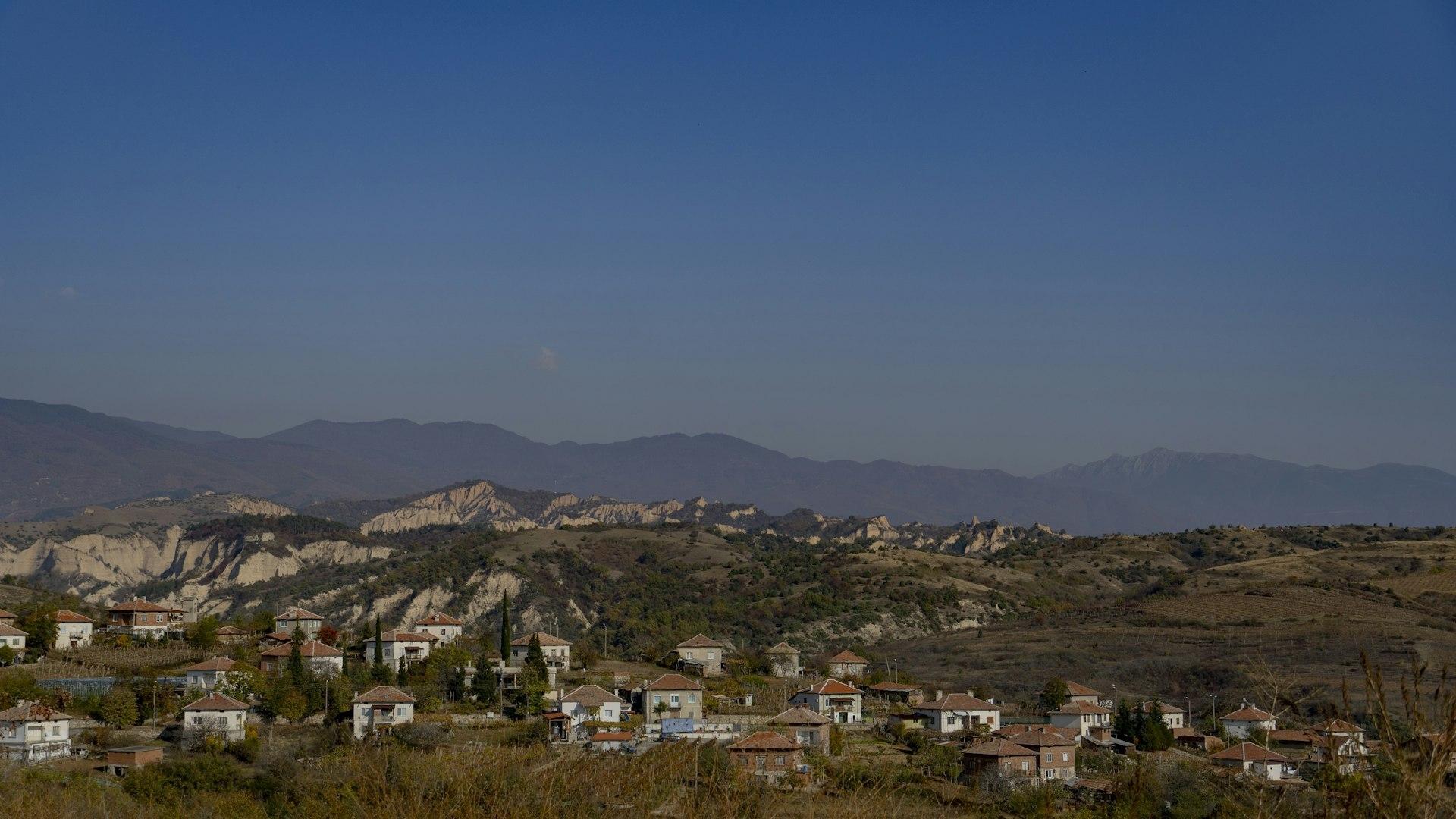
Property in Sandanski: Bulgaria's warmest climate, mineral springs and houses below Pirin — what to check before you buy
Sandanski is the town people from Sofia and northern Bulgaria choose when they want more sun and a shorter winter. The buyers are varied — families looking for a second home, retirees who want to live somewhere warm, people with respiratory problems, investors in guest houses. But the climate that makes the town attractive also shapes what you need to check when buying.
Here is what we look at when a client is searching for property in and around Sandanski.
This is a general description based on our experience; every street and every plot has its own particulars.
What the town is like
Sandanski lies in Blagoevgrad province, in the Sandanski–Petrich valley, at the south-western foot of the Pirin mountains along the Sandanska Bistritsa river. Sofia is about 160 km away along the E79, and the Greek border about 20 km. Until 1947 the town was called Sveti Vrach; the remains of the ancient city of Parthicopolis are nearby.
The climate. Sandanski is one of the warmest places in Bulgaria. Climate data show more than 2,600 hours of sunshine a year; winters are short and mild, while summers are hot and dry, with heatwaves above 40 °C (the record is 44.6 °C).
The water. According to Bulgaria's Ministry of Tourism, the area has about 80 mineral springs grouped into 13 deposits, with temperatures of up to 83 °C. The waters are used to treat musculoskeletal, nervous-system and skin-allergy conditions, and the town is best known for treating bronchial asthma thanks to the combination of water and climate.
Close by are Melnik (about 24 km) — Bulgaria's smallest town, known for its architecture and wine — and Rozhen Monastery.
1. The climate changes what you check in a house
Buyers used to cold winters often look only at the heating. In Sandanski the more important question is how the property copes with summer.
- Orientation and shade. A home with large west-facing windows can be hard to live in during July and August. View the property in the afternoon, not just the morning.
- Insulation. It matters here too — it keeps the heat out in summer. Top-floor flats and houses with an uninsulated roof overheat the most.
- Air conditioning. Check how many units there are, how old they are and whether the wiring can cope. In an apartment block, new units on the facade come with their own rules.
- Water for the garden. Hot summers mean watering. Ask where garden water comes from — the mains, a well or a borehole — and whether there are permits for it.
- The bills. Ask for a full year of electricity bills — in Sandanski the summer bills are often higher than the winter ones.
2. Mineral water and "spa" in the listing
As in other spa towns, the mineral water is not part of the property you buy — the deposits are state property and their use is governed by the Water Act. If a listing says "house with mineral water" or "complex with spa", ask for the paperwork: a supply contract, invoices, and a borehole permit if there is one. We go into detail in our guide to property in Velingrad — the same rules apply.
3. An earthquake zone: the structure matters
The Struma valley is one of the most seismically active areas in Bulgaria. The earthquakes of 4 April 1904 around Krupnik and Kresna, north of Sandanski, are among the strongest ever recorded in Europe.
That is no reason to walk away from a purchase, but it is a reason to take the structure seriously.
- Year and type of construction. For a new building, ask for the occupancy permit (Act 16) and the designs. For an older house, find out what it is built of.
- Extensions and extra floors. A floor added on top of an old house without a design is a risk not only legally but structurally. Ask for the building documents for every part.
- Cracks. Diagonal cracks in walls and around doors and windows are a signal to bring in a structural engineer before the deal.
- Insurance. Ask the insurer whether the policy covers earthquakes and with what deductible.
4. Village houses, vineyards and Melnik
Much of the demand is for houses in the villages around Sandanski and in the Melnik area — with a yard, a vineyard and a view of Pirin.
- Is the plot within the regulation plan? If the "garden" is really farmland or a vineyard outside the plan, you cannot build on it without a change of land use under the Agricultural Land Protection Act.
- Access. Check there is a road under the plan or at least a registered right of way. A dirt track across someone else's vineyard is not a right of passage.
- Melnik. The town is an architectural reserve, and 96 of its buildings are cultural monuments. Renovating, extending or replacing the windows of such a building requires approval under the Cultural Heritage Act. Budget the time and cost before you buy.
- Protected areas. The area sits between Pirin and the Struma valley. Check whether the property falls within Pirin National Park, forest land or a Natura 2000 protected zone.
5. The road to Sofia and to Greece
South of Sandanski, the Struma motorway reaches the border at Kulata — the stretch to the border has been open since 2015. North of the town, however, traffic still runs through the Kresna Gorge; what is planned there is covered in our article on the EIA for the new carriageway. If you will travel to Sofia often, try the drive on a Friday afternoon before you decide.
6. Second home and letting to guests
Spa tourism and the mild climate sustain demand for stays outside the summer season. If you are buying to let:
- paid overnight stays require categorisation or registration under the Tourism Act, and platform listings must also comply with the EU rules — see our guide to short-term letting;
- calculate the yield on real year-round occupancy, not on peak weekends;
- competition from spa hotels is strong — a property with air conditioning in every room, parking and shade lets more easily.
Purchase costs
On top of the price, budget for the local acquisition tax, notary fees and the registration fee. The tax is set by each municipal council within a range of 0.1% to 3% — our guide to the local acquisition tax explains how to check the rate. Check the current rate in Sandanski Municipality's ordinance. All amounts are indicative.
Sandanski checklist
- Summer? → orientation, shade, roof insulation, air conditioning, a full year of bills.
- Garden water? → mains, well or borehole and its permit.
- "Mineral water" or "spa"? → contract, invoices, permit.
- Structure? → year and type of construction, documents for every extension, cracks, earthquake cover.
- Village house with a vineyard? → regulation plan, road access, farmland status, Natura 2000.
- Property in Melnik? → is it a cultural monument, what approval is required.
- Letting? → categorisation or registration, real occupancy.
In brief
Sandanski offers a combination that is rare in Bulgaria — a warm climate, mineral water, and Pirin and Melnik on the doorstep. But when buying here you need to think about summer more than winter, and about the structure more than in most other towns.
If you are considering property in Sandanski or the Melnik area, call us or visit our office. We will go through the documents together and tell you honestly what we see.
The information is general and indicative and is not a substitute for professional advice.

