
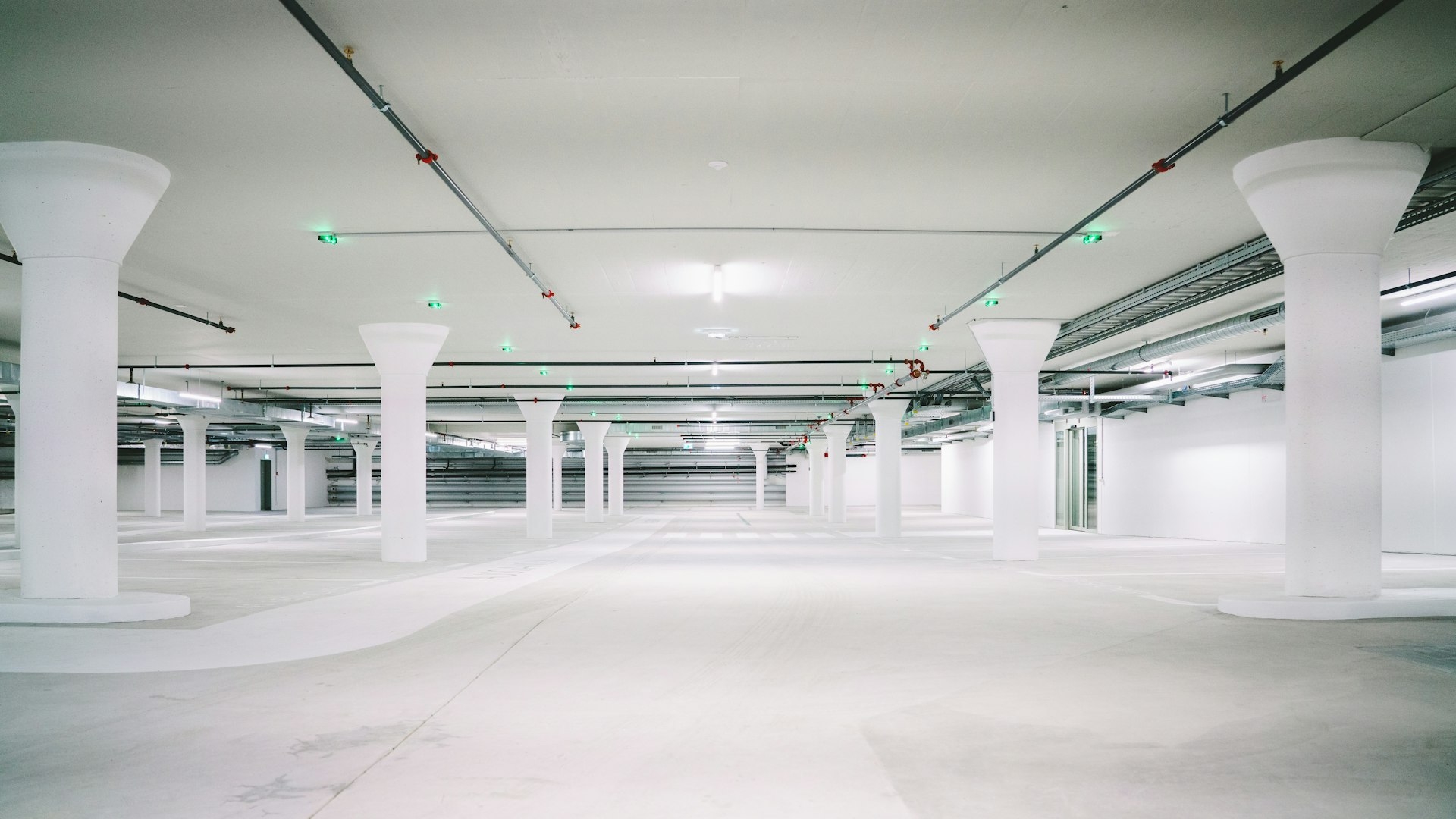
"Buying a parking space" sounds simple, but in Bulgarian law it can mean at least four different things: a garage that is a separate property with its own cadastral identifier, a share in a shared underground car park, a space that is a common part of the building, or simply the right to park in the yard. Which one you are buying decides whether you can ever sell it on its own, how it appears in the title deed, who pays for upkeep and whether you can install a charger. Here is what to check before you pay. Verified October 2026.
Since the end of 2015, the Spatial Development Act (ЗУТ) has required parking in condominium buildings to be set out in the building's design project in one of three ways (Art. 37(4) ЗУТ). Parking in the yard is the fourth common case.
| Status in the project | What you actually acquire | Can it be sold separately? |
|---|---|---|
| Garage or car park as a separate unit | The whole unit (a lock-up garage) or undivided shares in a shared underground car park, plus an agreed specific space | Yes – it is real property with a cadastral identifier |
| Car park as a common part of the building | Nothing separate – only the right to use a space allocated by the owners' general meeting | No – common parts cannot be sold on their own |
| Spaces attached to the flats (as an "accessory", like a cellar) | The space follows the flat | On the prevailing view – only together with the flat, or to another owner in the same building |
| Space in the yard | A right to use part of the plot | No – use is allocated, not ownership |
A space painted on the floor is not a separate object of ownership. A listing that says "parking space no. 12 for sale" without saying which regime applies should prompt questions.
If the garage is a separate unit, it has its own cadastral identifier and is transferred by notarial deed like any other property. With a lock-up garage you buy the whole unit.
With a shared underground car park that is a separate unit, you become a co-owner: you acquire a fraction of the whole car park (ramp and driving aisles included), and your specific space is yours under an agreement on how use is split. So check:
If the project designates the car park as a common part, nobody can sell it to you separately – even a signed contract does not make you an owner. Use is allocated by the condominium's general meeting.
For the yard, the law is explicit: where the plot is a common part, parking can be provided by the general meeting allocating the use of part of the free yard area, while keeping the minimum mandatory green area (Art. 43(3) ЗУТ). That is a right of use set by a decision – not property you can buy or mortgage. If a seller promises a "reserved space in the yard", ask for the general meeting minutes.
If you are buying with a loan, ask the bank early whether it will finance the space and how it treats it as collateral – a separate garage, a share and an accessory space are handled differently. You can estimate notary and registration costs with our notary calculator.
For new buildings, the required garages and parking spaces must in principle be provided within the plot (Art. 43(1) ЗУТ). The authority issuing the building permit may allow exceptions for technical or regulatory reasons – plot size or slope, groundwater conditions and so on (Art. 43(2) ЗУТ). The required number is set by the ordinance under Art. 75(4) ЗУТ. In practice, if a new building has fewer spaces than flats, there will be competition for them – and a price.
Since late September 2023, ЗУЕС expressly provides for a general meeting decision on installing charging points for electric vehicles, by a majority of more than 50% of the ownership shares in the common parts (Art. 17(2)(6) ЗУЕС). Running cables and panels through common parts therefore does not need unanimity. If the car park is a separately co-owned unit, you will also need consent under the rules for managing co-owned property. Before buying, ask whether supply and capacity for chargers have been planned.
Before you pay for a parking space, find out what it is under the project – a separate unit, a share, a common part, an accessory or a space in the yard. Everything else follows from that: the deed, the loan, the tax, the upkeep and whether you will ever be able to sell it.
This article is general information, not legal or tax advice for a specific case.
If you are considering a home with a garage or parking space, call us or visit our office – we will go through the documents with you before you commit.
