
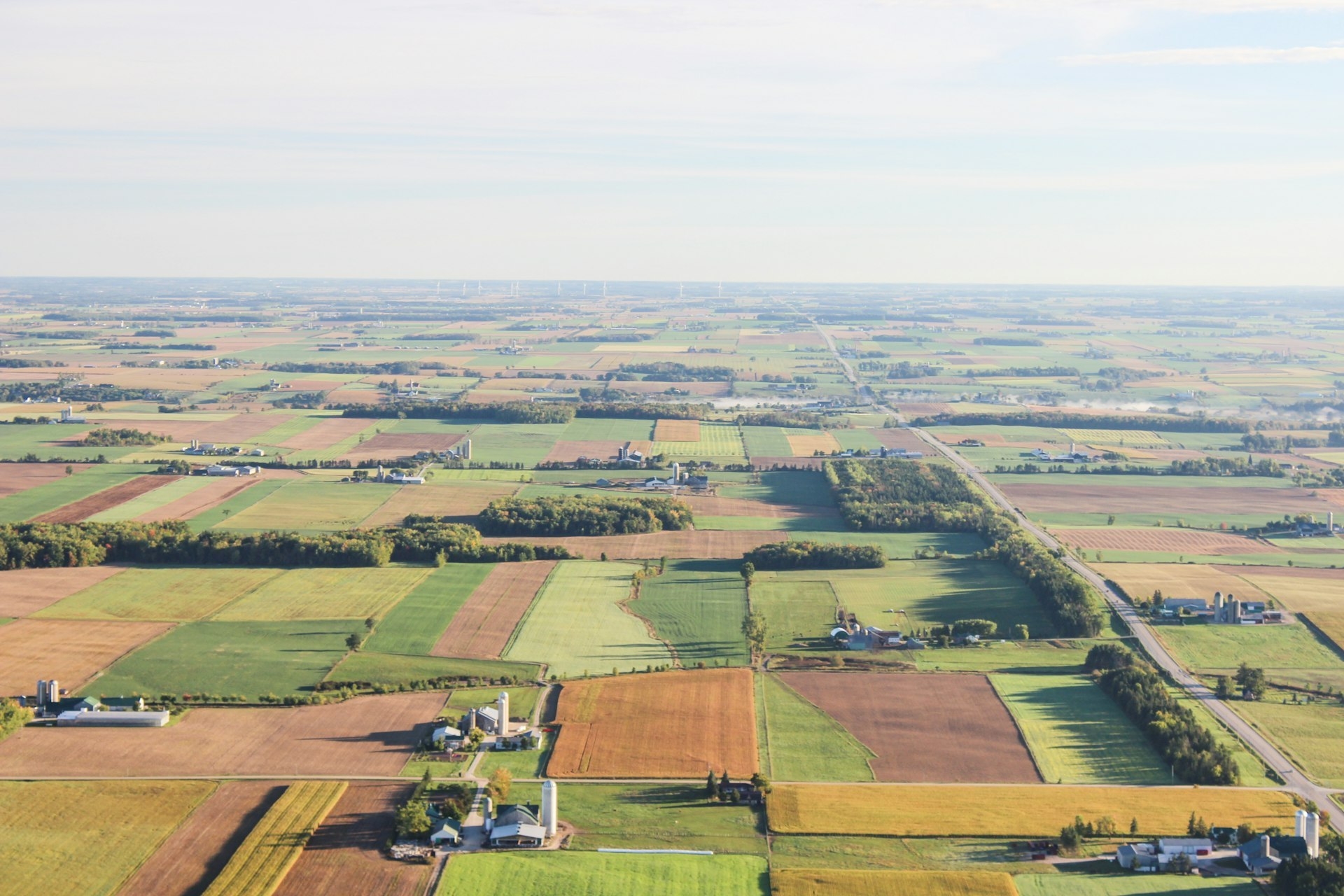
Plenty of people own fields — inherited, returned through restitution, or bought "just in case". Others ask whether farmland is a good home for their savings. The answer depends on what you expect from it. Land is a stable but slow asset, with a low yield and its own rules, quite different from those for an apartment.
This guide is about land that will stay agricultural. If you want to build, read our guide to buying a plot for a house first. It explains why changing the land's designation is a separate, slow and uncertain procedure.
According to NSI data for 2025 (published in 2026; converted to euro at the fixed rate, our arithmetic):
| Indicator (national average, per decare = 1,000 sq m) | 2025 | Change on 2024 |
|---|---|---|
| Price of arable land | ≈ €843 | −3.3% |
| Price of meadow or pasture | ≈ €145 | −4.0% |
| Rent (lease or rental) for arable land | ≈ €26 | −12.1% |
| Rent for meadow or pasture | ≈ €10 | −13.0% |
Regional differences are large. Arable land is most expensive in the North-East (≈ €1,070 per decare), which also has the highest rent (≈ €34 per decare). It is cheapest in the South-West (≈ €562 per decare, rent ≈ €16).
Dividing the average rent by the average price gives a gross yield on arable land of about 3% a year (our calculation). That is lower than for a let apartment. Against it, costs and effort are lower: no repairs, no tenant turnover every year or two, and no annual property tax, as explained below.
After years of rising prices, 2025 brought a fall in both prices and rents. Do not buy land expecting quick growth. It is a long-term asset.
| Agricultural lease (аренда, Agricultural Lease Act) | Rental over 1 year (Agricultural Land Act) | |
|---|---|---|
| Minimum term | 5 farming years (1 October to 1 October) | none |
| Form | written, with notarised signatures | written, with notarised signatures |
| Registration | in the Registry Office + registration with the municipal agriculture office | registered; recorded for land use |
| Who signs for co-owned land | co-owners holding more than 50% | co-owners holding more than 25% |
| Termination for non-payment | if rent is more than 3 months late | under general rules and the contract |
A few more rules on agricultural leases:
A lease suits you if you want a stable tenant for a long period. A rental gives flexibility if you may sell or seek a change of designation.
If your land is not let, check with the municipal agriculture office whether it is being farmed as a "white spot" within a consolidated block. They can also tell you what you are owed as the owner.
On purchase:
While you own it: undeveloped agricultural land is not subject to annual property tax. If there is a building on it, tax is due only on the built-up area and the land around it.
When you let it: income that individuals receive from leasing or renting out agricultural land is tax-exempt (Art. 13(1)(24) of the Personal Income Tax Act, ЗДДФЛ). That is a major difference from letting a home, where tax is due. The rules for homes are covered here.
When you sell: the general rules on tax when selling property apply, including the five-year holding period. The tax authority applies that period to farmland too. Details are in our guide to tax when selling property.
Farmland makes sense if:
Be more cautious if you are counting on a quick resale or a change of designation. Small, fragmented fields are hard to sell, and a change of designation is never guaranteed.
Verified October 2026. Prices and rents are national averages from NSI data for 2025 and are indicative. This is general information, not legal or tax advice for a specific case.
If you have fields you want to sell or let, or you are thinking of buying land, call us or visit our office. We will go through the documents and tell you what is realistic for the specific property.
