
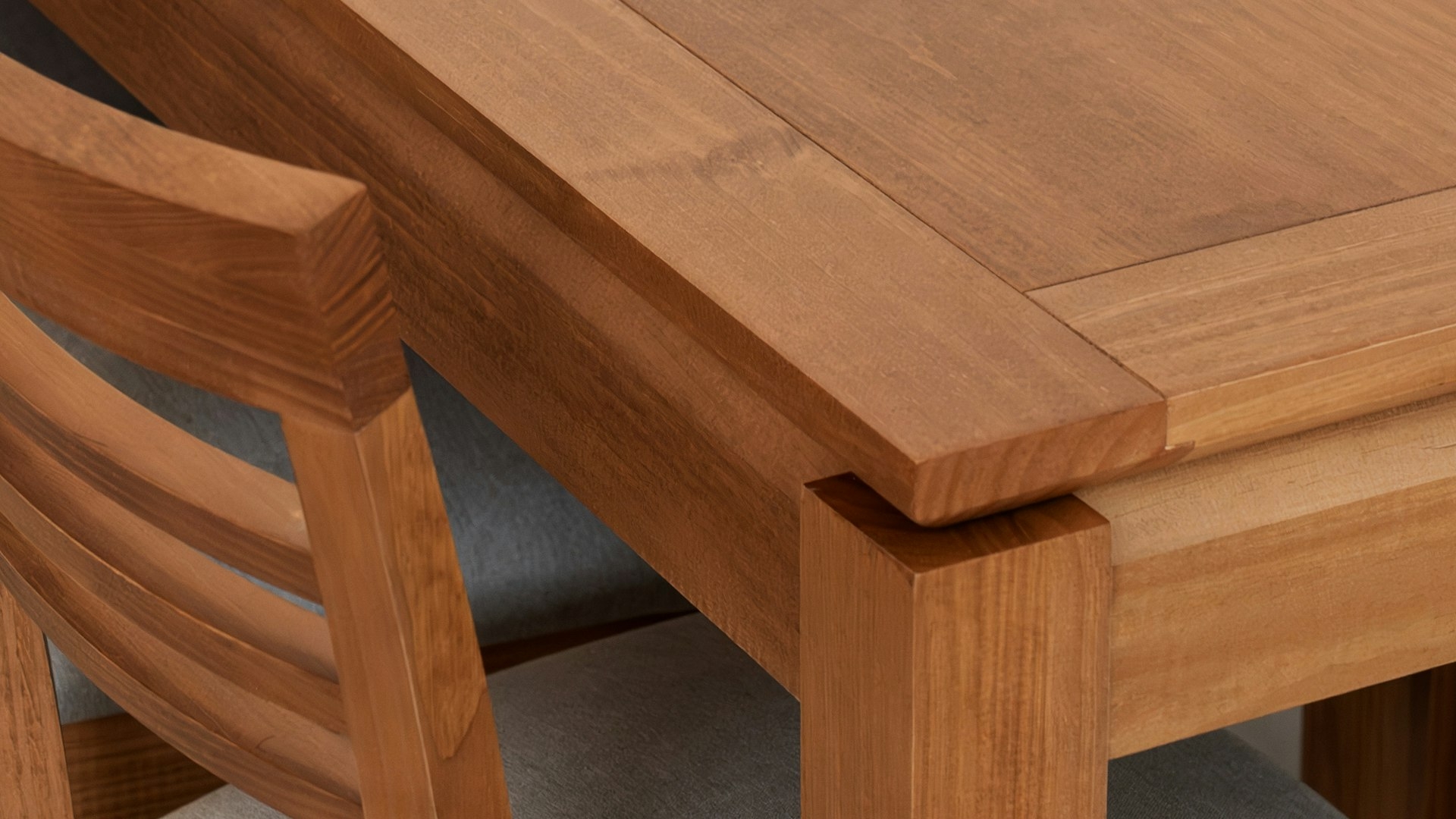
Buyers of a new flat usually furnish it in one go: kitchen, wardrobes, beds, tables — all within a few weeks. The same applies to an owner preparing a flat to let. The result is a large amount of new material in a closed, often well-insulated space. The European Commission says it plainly: wood-based panels and furniture are the main sources of formaldehyde in indoor air, in particular in newly built homes (recital 27 of Regulation (EU) 2023/1464). Here is how to choose sensibly without paying for labels that mean nothing.
| Material | What it is | What to watch |
|---|---|---|
| Solid wood | whole boards from one piece of timber, or glued lamellas | its formaldehyde is natural (released as lignin breaks down) and excluded from the new limit; watch the lacquer, glues and paint instead |
| Chipboard / particleboard (ПДЧ) | pressed wood chips with resin, usually with a laminate surface | the most common carcass material; emissions depend on the resin and on whether edges are sealed |
| MDF | pressed wood fibres with resin | smooth, easy-to-paint fronts; also depends on the resin |
| Plywood (шперплат) | thin veneers glued in layers | strong and light; the glue determines emissions |
Wood-based panels are not a "bad" material — most modern kitchens and wardrobes are made of them. What matters is the emission class and sealed edges: an unsealed edge or drilled hole is where a panel "breathes" most.
Regulation (EU) 2023/1464 adds entry 77 to Annex XVII of REACH. From 6 August 2026, articles may not be placed on the EU market if, when tested in a chamber under the conditions set out in the regulation (Appendix 14), the concentration of formaldehyde released exceeds:
For the interior of road vehicles, the 0.062 mg/m³ limit applies from 6 August 2027.
What matters for you:
E1 is the emission class for wood-based panels, measured in a chamber under the EN 717-1 standard; it corresponds to 0.124 mg/m³. The European Panel Federation (EPF) has long proposed "½ E1" — half of E1 — as a lower market class. That value is in practice the same as the new legal limit for furniture, 0.062 mg/m³.
Labels such as "E0.5", "E05" or "E0" are not a single official EU class — different manufacturers use them to mean different things. If a seller quotes one, ask which test method was used and what the result is in mg/m³.
FSC and PEFC certify the origin of the wood — that it comes from responsibly managed forests or recycled material. They are not emission certificates.
FSC uses three labels: FSC 100% (all from certified forests), FSC Mix (a blend of certified, recycled and "controlled" material) and FSC Recycled (entirely recycled). A genuine label carries a licence code FSC-C followed by six digits, and a company's certificate can be checked in FSC's public database. PEFC also has its own label and a public database of certified companies.
The EU Ecolabel for furniture goes further. Its criteria (Decision (EU) 2016/1332, valid until 31 December 2029 after the extension by Decision (EU) 2026/66) require, where wood exceeds 5% of the product's weight:
Ecolabelled furniture is still rare in Bulgarian shops, but if you see it, you know what stands behind it.
Water-based lacquers and paints contain less solvent than solvent-based ones and smell less when applied. Natural wood treated only with oil, wax or soap is a separate category — easier to refresh, but it needs upkeep. Paints and adhesives in the home are covered in a separate guide on healthy indoor air.
The greenest piece of furniture is the one that is not thrown away after five years. A solid table can be sanded and refinished; a well-built panel cabinet with quality hinges and fittings lasts for decades. Check:
New furniture emits most in the first weeks and months. Practical steps:
If you are buying off-plan or a shell flat, the furnishing budget is part of the overall sum — see what the second budget costs before you move in. For style and layout, see our guide to decorating your own home.
Call us or visit our office if you are looking for a home and would like to talk through what to check in it before you start furnishing.
