
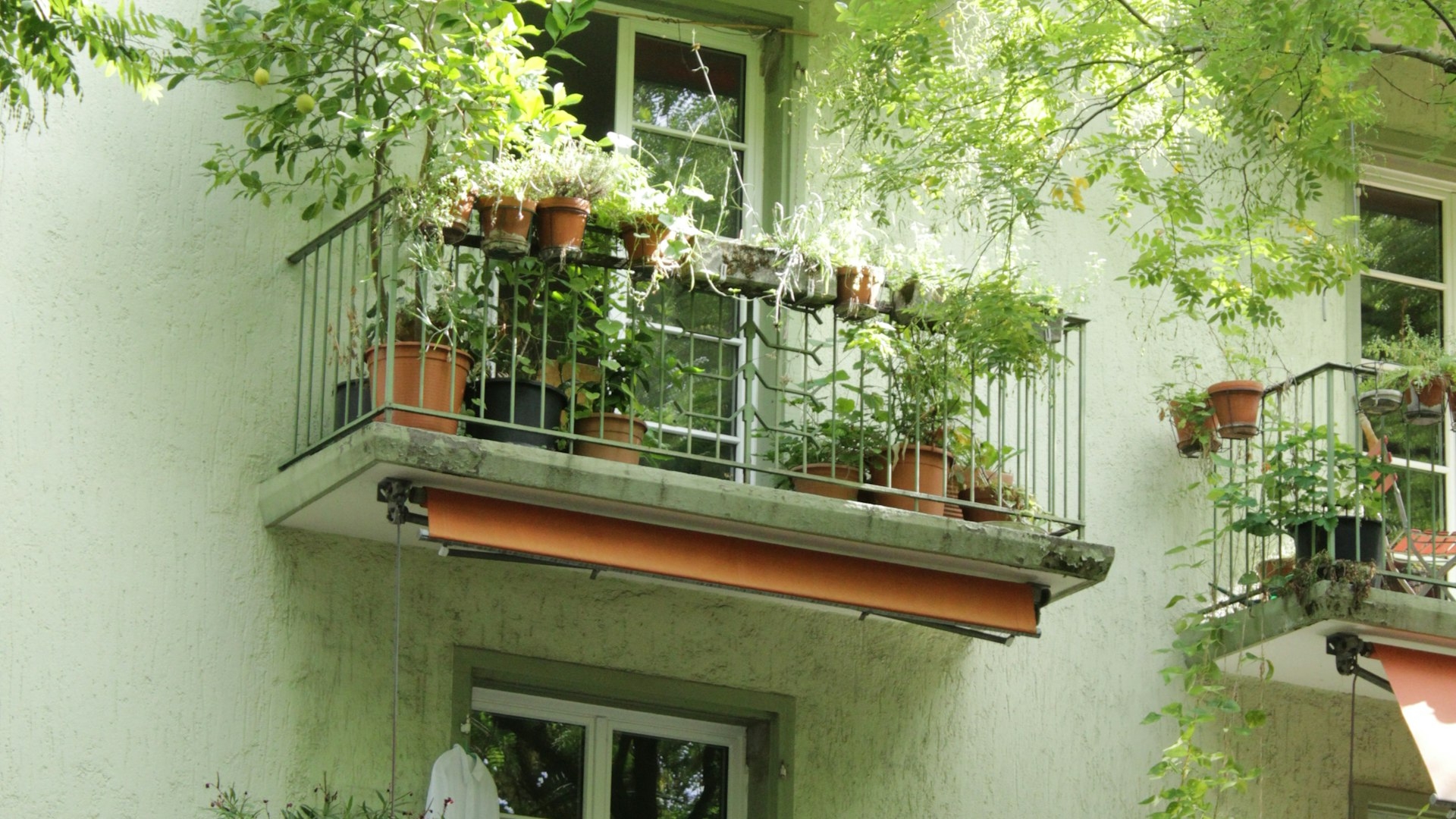
For most city dwellers, the balcony is the closest thing to a garden. A well-kept balcony is also a selling point when you sell or let the flat. But pots in an apartment block come with rules of their own: water runs down, pots fall down, and the façade belongs to everyone. Here is how to keep both your plants and your neighbours happy.
Before buying the first plant, watch your balcony for a day:
Allow for height too: upper floors are windier, and wind dries plants out and breaks stems.
The Sofia plain has cold winters and hot, dry summers. On the plant-hardiness zone map (per Plantmaps), Sofia is zone 7a — average winter lows of roughly −18 to −15 °C — Plovdiv is 7b, and Varna and Burgas are 8a, i.e. milder. Note that roots in a pot are more exposed to cold than roots in the ground, so on an open balcony choose plants with some margin.
| Aspect | Year-round | Seasonal (annuals, or overwintered indoors) |
|---|---|---|
| Sun (south, west) | lavender, thyme, sage; rosemary — with protection in cold winters | pelargoniums ("geraniums"), petunias, basil |
| Part shade (east) | box, ivy, heuchera | begonias, fuchsias, parsley |
| Shade (north) | ivy, hardy ferns | begonias, busy Lizzies |
| Winter and early spring | pansies and violas, primulas, cyclamen | bulbs — tulips, daffodils, muscari, planted in autumn |
The winter-container and evergreen-herb choices follow the UK Royal Horticultural Society's (RHS) container advice. Pelargoniums and other tender plants cannot take frost — put them out only once the forecast no longer shows spring frosts, and bring them in before the first autumn ones.
This is where most disputes in a block start. Water draining from pots ends up on the façade, on someone's laundry or on the balcony below.
The law is clear in principle: under Art. 6(1)(2) of the Condominium Management Act (ЗУЕС), owners must not cause damage to other units or to the common parts, and the building's external walls are a common part (Art. 38(1) of the Property Act). If water from your balcony damages a neighbour's home — stains, mould, damaged render — expect them to come to you. Whether your policy covers that kind of damage is discussed in our home insurance guide.
Wet soil, a large ceramic pot and a solid timber planter weigh far more than they look. We can't give you a precise limit — it depends on the structure of the particular building. The general rules:
Window boxes hung on the outside of the railing look lovely, but a pot falling from the fourth floor can hurt someone. So:
Balcony-specific rules are often found in the building's house rules (правилник за вътрешния ред), adopted by the general meeting of owners (Art. 11(1)(1) ЗУЕС) and binding on all owners (Art. 6(1)(15) and (20)). Check them, and your municipality's ordinances, before hanging boxes over the street. How to find out who manages your building and where its documents are is covered in our article on the building-manager register.
| Open | Glazed | |
|---|---|---|
| Winter | full cold; hardy plants only | warmer — tender plants can overwinter |
| Summer | rain and airflow | overheating when south-facing; needs blinds and opening |
| Damp | low risk | condensation and mould if not ventilated |
| Watering | rain helps | entirely up to you |
Glazing changes the façade and is a separate subject — agree it with the owners' association before you go ahead.
In our practice, a well-kept balcony helps a lot at viewings and in photos — especially in summer and in small flats, where it works as "one more room". A few tips:
If you are selling or letting a flat with a balcony and want to show it at its best, give us a call or drop by our office. We'll tell you what to keep and what to put away before viewings.
This is general information, not legal advice for a specific case. Information verified October 2026.
