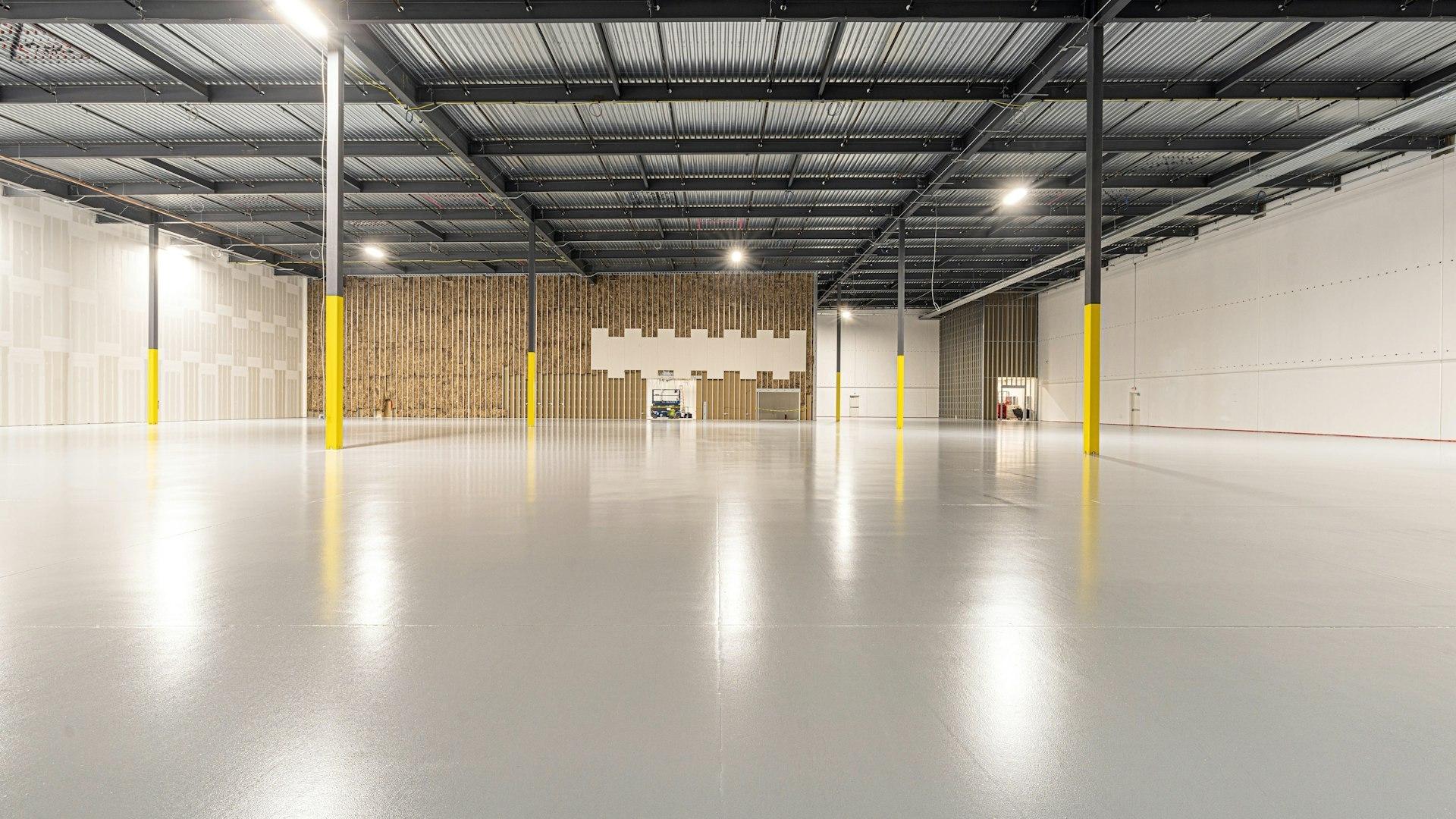
A small warehouse or industrial unit as an investment in Bulgaria: zoning, technical checks, tenants, VAT on the rent and how to work out the yield
Warehouses are the tightest segment of Sofia's commercial property market. According to Colliers' third-quarter 2026 figures, vacancy in modern speculative warehouse space is just 1.3%, rents are holding at €6/sq m a month for Class A and €4.50 for Class B, and the prime yield is 7.50% — more than double that of housing (details in our report on Sofia commercial property after Q3 2026 and our H1 2026 warehouse market review).
Those numbers describe the big logistics parks. A private investor usually buys something much smaller — a few hundred square metres of storage, a small hall in an industrial zone, or an old production building. The logic is similar, but the checks are not the ones you would run on an apartment. Here is what to watch.
What you are actually buying: four formats
- A unit in a warehouse or logistics complex — standardised, with shared roads and security; easy to let, but with service charges.
- A standalone small hall on its own plot — more control, but also more responsibility for the roof, fence and infrastructure.
- Showroom plus storage — a retail front with warehousing behind; popular with traders, but highly location-dependent.
- An old production or storage building — cheaper, but often without a full set of documents, with dated services and an unknown history on the site.
First: the zoning
Before anything else, check what the detailed development plan (ПУП) allows on the plot. Under Ordinance No. 7 of 2003 there are two main production zones:
| Zone | What it allows | Plot coverage | Floor-area ratio |
|---|---|---|---|
| Пп — predominantly production (Art. 25) | production without harmful emissions, warehouses, service buildings | 40–80% | 1.0–2.5 |
| Пч — purely production (Art. 24) | production and storage buildings only (plus limited service buildings) | 50–80% | 1.0–2.5 |
Both zones require 20–40% of the plot to be landscaped. This matters if you are thinking of extending: how much more can be built depends on these parameters and on what already stands there.
If the property sits on agricultural land or in a residential zone, warehousing may not be permitted at all, or may require a change to the plan — which takes months, sometimes years.
The documents: can the building lawfully be used as a warehouse?
Ask for the document that brought the building into use — a certificate of entry into service or a use permit, depending on its category. Older buildings often lack one, and other evidence of lawfulness has to be found.
Check the designated use on the documents as well. If you buy a warehouse but your tenant wants to manufacture or sell on site, the use may need to change. Where no building works are needed, this is done with a change-of-use permit under Art. 147a of the Spatial Development Act (ЗУТ), issued by the municipal chief architect on the strength of positive fire-safety and public-health opinions. Where works are needed, the usual route of a design and building permit applies. More on the procedure in our change-of-use guide.
The technical checks that decide whether you will find a tenant
This is where a warehouse differs most from an apartment. Tenants look at function first:
- Clear height — to the underside of the beams or trusses, not the ridge. It decides whether racking will fit.
- The floor — load capacity, flatness, cracks. Re-pouring a floor is expensive.
- Doors and docks — sectional doors, loading docks, whether a lorry can drive inside.
- Access and manoeuvring — can a lorry turn in the yard, what is the approach road like, are there heavy-vehicle restrictions?
- Electrical capacity — the power allocated under the contract with the distribution company. A tenant with cold rooms or machinery often needs more, and an upgrade takes time and money.
- The roof — leaks, insulation and, on older halls, whether the cladding is eternit (asbestos cement).
- Fire safety — storage buildings are class Ф5.2 under Ordinance No. Із-1971 on fire safety. The requirements (fire alarms, escape routes, sometimes sprinklers) depend on floor area and on what is stored. Ask explicitly what was approved and whether the building has been inspected.
On former industrial sites, also ask what was produced there. Soil contamination can become an expensive problem for any future construction or sale.
Who rents small warehouses
Tenants of small warehouses and halls are not the same as those in logistics parks: online retailers, importers and distributors, construction firms, workshops and small manufacturers, service businesses. They usually want:
- shorter terms than large occupiers, but with an option to extend;
- flexible layouts — an office or washroom inside the unit;
- predictable costs — a clear split of who pays utilities, security and maintenance.
In a non-residential lease, agree a deposit, rent indexation, who maintains the roof and building services, whether subletting is allowed, and what happens to the tenant's improvements when they leave.
Do not underestimate the void risk. An apartment in a good neighbourhood lets within weeks; a specific warehouse can wait months for a tenant. Make sure your yield survives a few empty months.
VAT: the first decision, not the last
This is the big difference from housing. Under Art. 45(4) of the VAT Act the only rent exempt from VAT is that of a building let as a home to an individual who is not a trader. Rent on a warehouse is a taxable supply at 20% when the landlord is VAT-registered.
What follows:
- On purchase. If the building is new — within 60 months of the use permit being issued — the sale carries VAT. If it is not new, the supply is normally exempt (Art. 45(3)), but the seller can opt to tax it (Art. 45(7)). If you are VAT-registered, you can usually recover the purchase VAT against the taxable rent.
- Registration. Mandatory VAT registration applies once your turnover for the calendar year exceeds €51,130 (Art. 96(1)). Voluntary registration is possible below that threshold.
- Tenants. For a VAT-registered business, VAT on the rent is usually not an extra cost, because it is recovered as input tax. For an unregistered tenant it makes the rent 20% dearer.
Whether to buy personally or through a company, and whether to register for VAT, is a decision to take with your accountant before signing, not after.
Tax on the rent
As an individual you pay 10% tax on the rent after 10% deemed expenses (Art. 31(1) of the Personal Income Tax Act) — roughly 9% in effect. If the tenant is a company or self-employed, they withhold and pay the advance tax with every payment (Art. 44(4)). Deadlines and returns are covered in our guide to tax on rental income.
Through a company you deduct actual costs and tax depreciation — up to 4% a year for solid buildings (Art. 55 of the Corporate Income Tax Act). How this works, and what happens on a sale, is explained in our guide to property held in a company.
Either way, building tax and the waste-collection fee stay with the owner unless the lease passes them to the tenant.
Working out the yield
An example (illustrative figures, not market prices): a 500 sq m warehouse let at €4.50/sq m a month (Colliers' Class B level for Sofia) brings in €27,000 a year. At a purchase price of €360,000, the gross yield is 7.5%.
For the real yield, deduct:
- void months — allow at least one or two a year;
- maintenance — roof, doors, services, yard;
- insurance, building tax and the waste fee, unless the tenant pays them;
- income tax and accounting costs.
Compare the result with the alternatives — for example an office as an investment or a residential let. The higher gross yield on warehouses comes with a greater void risk and fewer potential buyers when you sell.
A short pre-purchase checklist
- Development plan and zone (Пп or Пч) — is storage allowed, and how much more can be built?
- Certificate of entry into service and designated use on the documents.
- Clear height, floor, doors, docks, lorry access.
- Allocated electrical capacity under the distribution contract.
- Roof and any eternit cladding; condition of the services.
- Fire safety — approved measures and inspections.
- VAT treatment of the purchase and the future rent — decided with an accountant.
- Any existing lease — term, rent, deposit, indexation.
In short
A small warehouse can out-yield an apartment, especially with today's shortage of storage space. But you buy it with different eyes: zoning, occupancy documents, technical specification and VAT matter more than the view or the neighbourhood.
We also specialise in letting commercial and industrial property. If you are considering buying a warehouse or a hall — or want to know how quickly and at what rent a specific unit will let — call us or come into the office.
This is general information, not legal or tax advice. Market data are Colliers' figures for Q3 2026; legislation verified as of 28 November 2026.